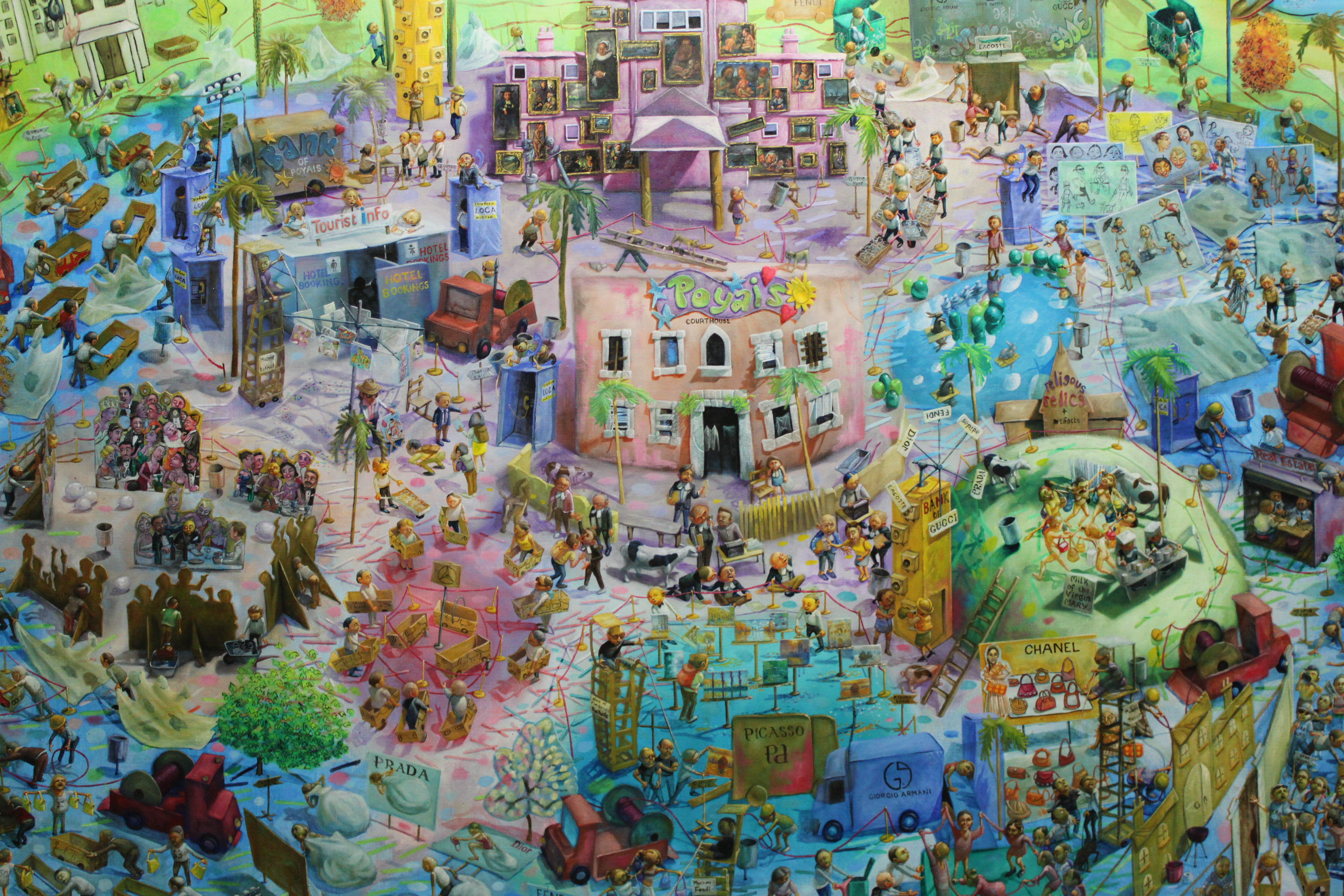
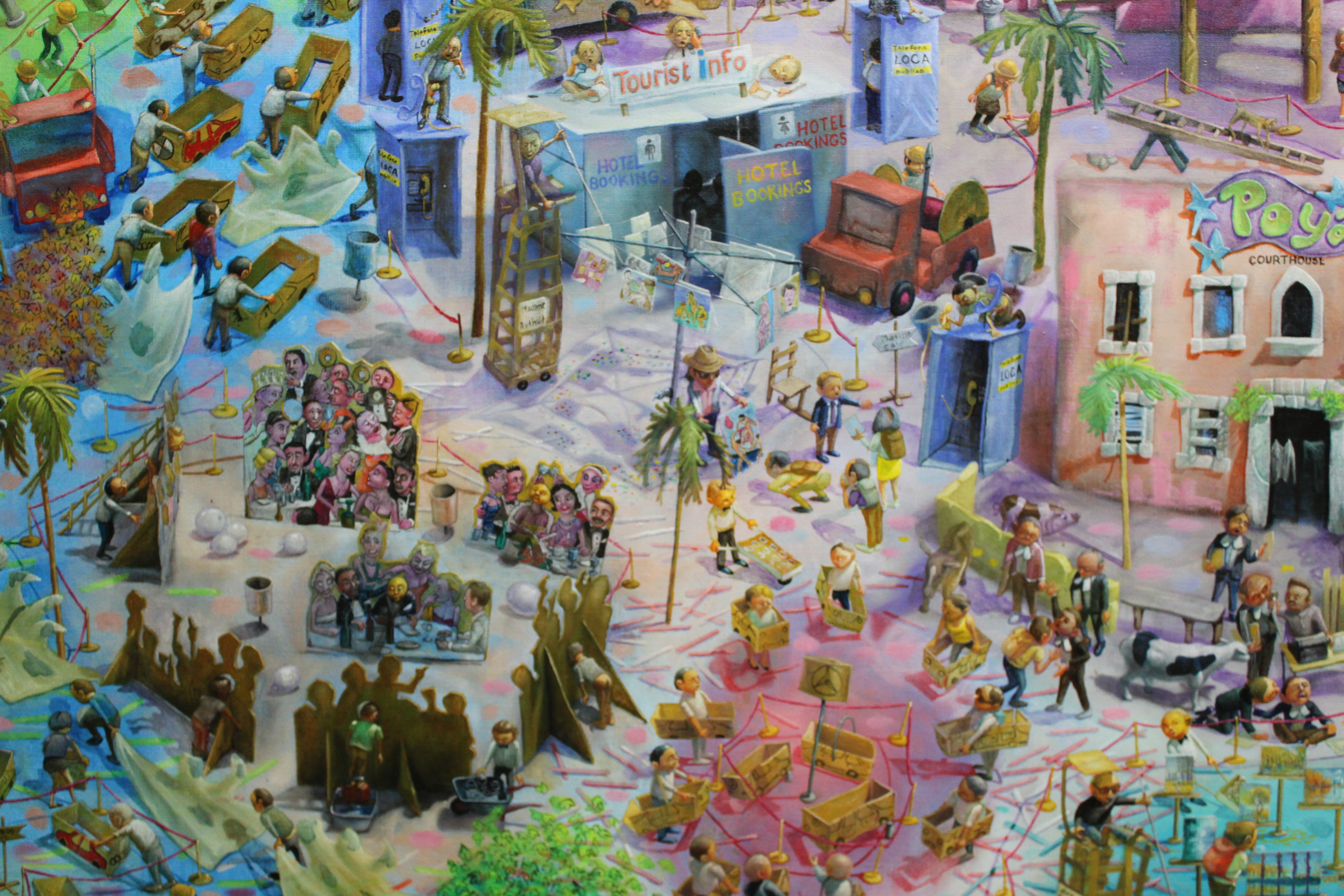
Elmyr de Hory and Fernand Legros in Poyais.

Opening 6-8pm Tuesday 30 May, Australian Galleries, 28 Derby St. Collingwood
During the 1950’s there was many “houses of the stars “ tours in Hollywood. Amongst the
hundreds of excited and guilable waiting in front of Grauman’s Chinese Theatre to be picked
up by a painted over school bus was once Elmyr De Hory and at another time Fernand
Legros. The host of the “houses of the stars “ tour stands in the front of the bus and tells the
passengers which star’s house the bus will stopping at next. The gaping passengers are told
that behind this latest in a series of tall and wide, brick and stuccoed walls lives Fred Astaire.
The passengers take photos of the wall and lean into it and perhaps to hear the sound of a
shower draining or car starting up.
For the –soon to be – most successful art forgers in history, Elmyr de Hory and Fernand
Legros it was clear that the whispered name of the star was enough, all they had to do was
provide an old school bus and a big empty brick wall.
A passenger who came alone on the tour asks the host, rather routinely “how do we know
this is Fred Astaire’s house “.The host then walks to the letterbox in the wall and slides his
fingers into the letter slot and pulls out a letter addressed to “Mr. Frederick Astaire !”. The
gasping passengers line up to look. This detail is particulairly appreciated by Elmyr De Hory
and then later by Fernand Legros.
French social commentator/philosopher Jean Baudrillard suggested that Disneyland was
created so that Americans could be convinced of the reality of their own world by
comparison with the fantasy /unreal world of Disneyland. But Disneyland became so
successful that it grew to include the entire life of the average American. Baudrillard went
on to suggest that pornography was created to convince us that our sex was real, that
financial markets were created to convince us that our money was real and history was
created to convince use that our past was real. Art forgers Elmyr De Hory and Fernand
Legros found out that art history was created to convince us that important art was real.

LOST IN A SUPERMARKET
DeHory and Legros both orphaned early in their lives grew up during World War Two and
had a very urgent sense of the plasticity of both personal and public history. De Hory in
particular – a jewish, homosexual, Hungarian orphan surviving in Nazi occupied Germany
learnt the virtue of deceit. Both orphans used the freedom that came with not being
tethered to a family name and family members. They understood the possibilities that come
with the familyless brand of anonyminity and unaccountability. The two art forgers did not
live in a world of objects, places and people created by and for the past. Their world was a
great supermarket full of places , people and things that were there for their needs and for
their needs now. For De Hory and Legros facts, truth and honesty were verbs not nouns.
POYAIS
During a time of war military spokesmen are encouraged to use the language and imagery of
movie trailers when talking to the public about the progress of the war – that way the war will
sound real to them. Many people feel their romantic relationships aren’t real unless they have a
quirky first meeting story and an almost immediate obstacle to overcome like the love stories in
books and at the movies. For people to know an artwork is important it needs an origin story;
the artist’s mental illness, the artist’s persecution, the artist’s early friends and associates or in
the case of the Mona Lisa that the artwork was once stolen.
In 1820, at the time of the Colonizing frenzy, Gregor MacGregor made up a fake country called
the Republic of Poyais. He then opened offices in Edinburgh, Glasgow and London where he
sold Poyais real estate and exchanged real money for the Poyais the dollars his mate – who
worked at the mint printed for him. After months in a boat doing laps of South America, the few
Poyais investors who had survived the trip realised there was no Poyais but refused to accept
they’d been duped.
During the 50’s and 60’s Elmyr de Hory specialised in forging the fauves, the bright, simple and
unreal colours of Matisse, Dufy ect.. Fernand Legros was an illegal immigrant from Egypt who
pretended to be a former ballet dancer and with his lover Canadian backpacker Real Lessard
they sold De Hory’s forgeries to some of the biggest art museums and art collectors in Europe
and the U.S.
Once they approached the collectors and museum directors with a Matisse painting, Modigliani
drawing or a print by Picasso the excited/ frenzied buyers were interested only in knowing that
the artworks were real – really made by the names/the brands. No-one was interested in the
work itself.De Hory and Legros had to make the provenance first and then the art would follow.
De Hory and Legros proved that the fine art world was as brand gullible as any bunch of
branded – up teenagers you find loitering in any suburban shopping mall.

 cameronkhayes