Kick after the siren, Tapalinga Hawks vs Milikapiti Magpies

Cameron Hayes. Kick after the siren, Tapalinga Hawks vs Milikapiti Magpies – 3rd December 2002, 2004, 101 x 152.5 cms
If you see rubbish on the ground, why pick it up when you can set it on fire? If there’s a chair in the way of the TV, why move it when you can burn it to the ground? Just about every problem in Milikapiti can be solved by covering it in petrol and reducing it to ashes.
During burning season, you are woken up on Sunday mornings by kids in nappies walking around your backyard with a 1.25 litre plastic coke bottle full of petrol and a box of matches hoping to find some tiny shrub or blade of grass that hasn’t already been burnt to a crisp. Every house in Milikpiti has an iron drum constantly billowing smoke out the front, and the community dogs have to get up on hind legs and look into the fire for the less burning things to eat. Most Milikapiti dogs have burnt noses and tongues.
“History is subjective, people can pick out events and stories that they think are important.” And that is what Hayes is referring to by making up past dates to accompany the images in this body of work. This painting (above) was painted in Milikapiti. The artist’s local neighbours would visit him at work, an easel set up under the house. This painting was quite popular. Someone suggested it should be on display in the community club; another neighbour found it funny , stating it reminded her of how it used to be when she was a child. The community now has strict regulations regarding alcohol consumption, no alcohol was permitted at football matches while the artist was there. Hayes says of this work: “The main part of the story is how white Australian culture tries to order Tiwi life. In the background rubbish is burnt (Tiwi) rather than collected – rubbish pile burn offs, and this helps to explain why they are all over the field. One as an aesthetic device and two to reinforce the theme of the picture. Two ways of handling a problem in concert. Football is another analogy for white culture trying to order Tiwi life according to their rules, in this case footy rules. Here the whole team is standing on the mark, opposing team members are hugging. The rules work to a degree, but are adapted by the local culture, not fully accepted.
The beer cans I’ve used as an aesthetic device too. They are quite easily understood as they were everywhere, and on the footy field, the sun fades them and they become aqua in colour, they actually look quite beautiful. And when I was there it wasn’t a judgement that there were beer cans or that it was an embarrassment.”
This work was also included in the local art competition The Footy Art exhibition in 2005, where Kevin Sheedy (Essendon FC Coach at the time) awarded it First Prize. – M. Soni, June 2012.
Milikapiti netball bibs

Cameron Hayes, When a fight breaks out everyone is so related and allied that you can’t predict who will take which side even in football games, 2006, mixed media.
When a fight breaks out everyone is so related and allied that you can’t predict who will take which side even in football games. Whenever you’re talking to a Tiwi about other Tiwis you’re always thinking, am I talking about his brother, uncle, nephew, son…
The anthropologist Baldwin Spencer in the 1920s said that when there was a Tiwi battle, people kept changing sides so everyone just went home.
In Milikapiti the dogs hang out in packs

Cameron Hayes, In Milikapiti the dogs hang out in packs, 2008, mixed media, dimensions variable.
In Milikapiti the dogs hang out in packs. When two packs meet each other, the two lead dogs, instead of fighting each other, lie on their backs in acts of total submission, while their three or four bitches stand behind them chewing nappies.
The white men in Milikapiti are all called Les, and their way of being friendly is to convince you that they are not threat to you in any way. One of the white men in charge of water said – when I asked him a question – “What would I know? I’m just a fucking dumb cunt.”, while his wife stands behind him nodding approvingly. When two white Milikapiti men meet, it is a race to see who can degrade themselves as quickly and as completely as possible.
-

- Dog detail
-

- Dog detail
-

- Dog detail.
It took the nuns a couple of months to realise that more girls would attend PE class….

Cameron Hayes, It took the nuns a couple of months to realise that more girls would attend PE class if it involved less netballs and more shotguns – 4th May 1975, 2006, oil on linen, 91.5 x 137 cm.
It took the nuns a couple of months to realise that more girls would attend PE class if it involved less netballs and more shotguns.
When a really old Tiwi woman took all her clothes off and danced naked on the stage at the club, another really old Tiwi woman yelled at her, “Put your clothes on Joan, Your possum’s dead”.
Dr Clyde Fenton delivers yet another baby – March 7 1932
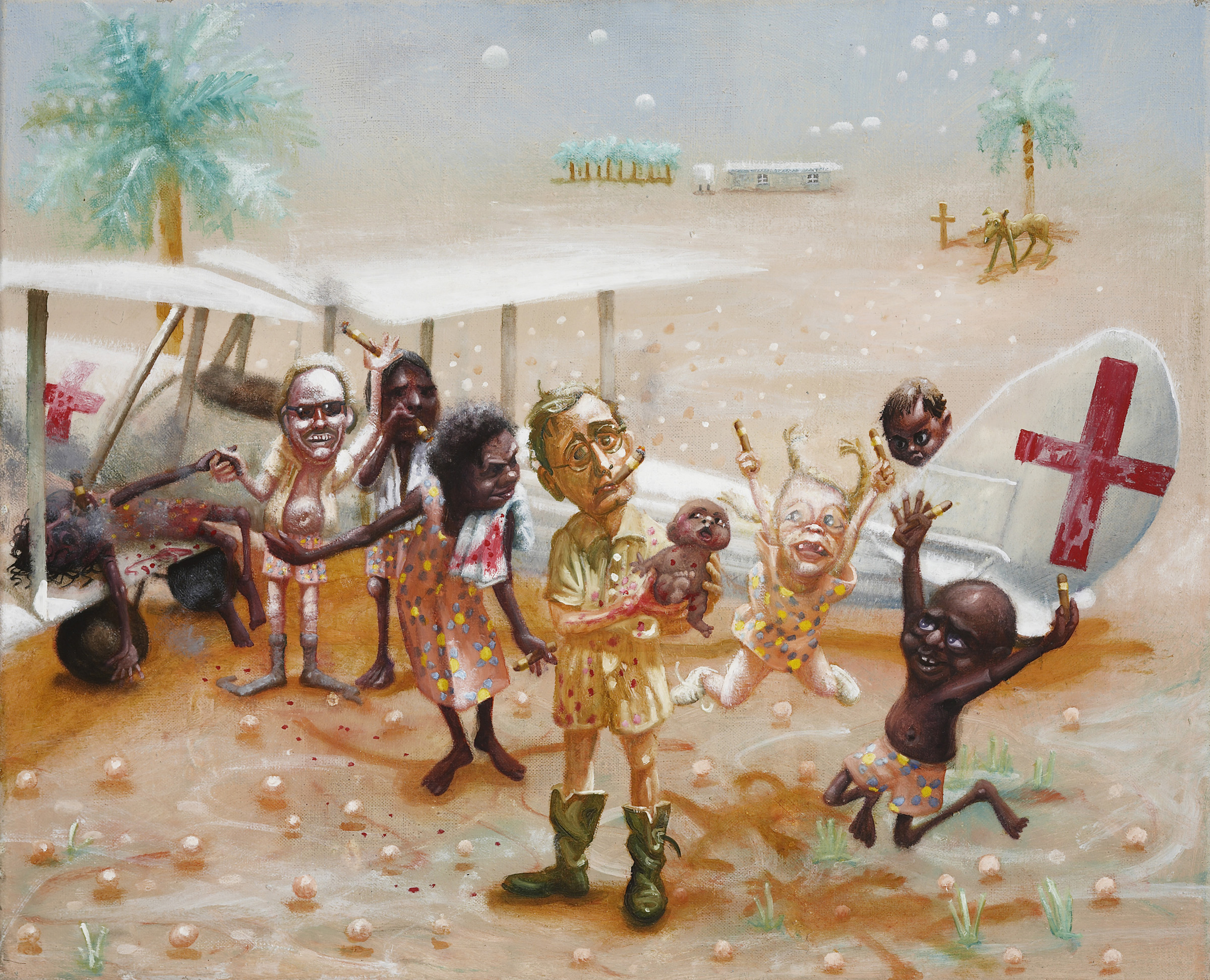
Dr Clyde Fenton delivers yet another baby – March 7 1932, 2006, oil on linen, 44.5 x 53.5 cm.
This is Dr Clyde Fenton. In the early 1930s he brought his own broken down old plane and made himself the first flying doctor in the NT. He attended Xavier College, and although he did graduate as a medical doctor in 1925 from Melbourne University, he was a self-taught pilot. A disaster to the Civil Aviation Department, but a hero to the Tiwi people, as he was their only hope for medical assistance at the time.
Despite having a free medical clinic, most Tiwis won’t get help until the absolute last minute. In Milikapiti there are 2 nurses and a doctor flies in on Mondays. Just about everyone walks around with something bandaged.
This is Doctor Clyde Fenton. In the early 1930s he brought his own broken down old plane and made himself the first flying doctor in the NT. According to his autobiography, Clyde Fenton’s sister died in China in 1936 while being visited by their mother. On the day he heard, Fenton flew from Katherine to Darwin, welded an extra fuel tank to his plane, put another fuel tank in the passenger seat, and flew from Darwin to China across the Timor Sea during cyclone season, while Japan were fighting with China, without any landing permits or visas, and without telling anyone or bringing any one, and anyone who complained was some kind of “blasted dim-witted bureaucrat”.
Interview on 7.30 Report
here is a link to my interview on the 7.30 report on the abc

Cameron Hayes
Dog torturers behind the Milikapiti Clinic, 2006
oil on linen
77 1/2 x 83 1/2 inches
Photo: Hermann Feldhaus
Courtesy Ronald Feldman Fine Arts, New York
Cameron Hayes exhibition opens in Melbourne today
Cameron Hayes’ extensive body of work created over the past 8 years – The Incomplete History of Milikapiti – will be on show at Dark Horse Experiment gallery in Melbourne from tonight until the 2nd September.
Come and visit the show. If you have any thoughts or questions, contact Cameron. He might even be in the gallery some days.
Have a read of this article about the body of work before you go. It’s pretty interesting. And, if you can’t get to Melbourne to see the show check out this blog and the Dark Horse Experiment website for the full catalogue.

Soft sculpture installation from The Incomplete History of Milikapiti. There are more weird, fun and wonderful sculptures in the show.
The Incomplete History of Milikapiti
When all the Whites came to Milikapiti, they gave all the Tiwis sugar, flour, beer and the dole. The Tiwi hunters – famed for their ferocity and courage – were no longer needed to hunt and kill food for the community. The Tiwi hunters had no purpose, so they lost their self-esteem and just sat around the club drinking beer.
Because the Tiwis ate only flour and sugar their teeth started to fall out. The government provided only one size of too big false teeth for everyone.
When the Whites gave all the Tiwis ladders, everyone could get their own mangoes, so the best tree climbers in the community lost their jobs and their importance, and drank beer. Because the Kookaburras got ladders, they no longer felt they needed to fly, so their wings shrank and they put on weight.
Which was fine until they met the King Brown snake, who remembered how things used to be and killed the kookaburras, whose now tiny wings could not fly their fat bodies away from King Brown’s bite.
King Brown’s poo covered the ground all over the Tiwi Islands and was a constant embarrassment to the people and the animals.
Is there anything more humiliating than seeing your father humiliated? When the government gave everyone the dole, the proud Tiwi warriors got the same amount of money as the obnoxious baseball-cap-backwards-wearing teenagers, who got the same amount as the old Tiwi women, who got the same amount as the guy who just sleeps in the broken-down old car all day.
When the Whites gave all the Tiwis glasses, the owls with the best eyesight felt valueless. They started stealing everybody’s glasses in the community, and sometimes this created domestic violence.
-

- Pole installation detail
-
- Kookaburra detail
-
- Crocodile detail
-

- Crab detail
-

- Crocodile detail
-

- Owl detail
-

- Crab detail
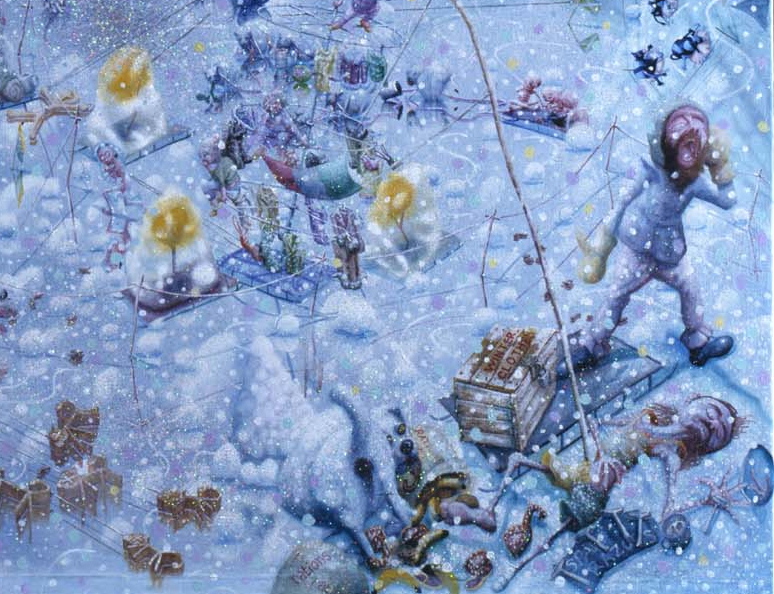
In the South Pole the explorers were so afraid of not having enough food…

In the South Pole the explorers were so afraid of not having enough food for winter that they starved to death in summer, 2001-2, oil and glitter on linen, polyptych 74 x 100 inches overall.
Polar explorers, including the famous competitors, Scott and Amundsden, would camp on the coast, and then set out on dog-powered sleds to the South Pole in spring. Many of the explorers were so terrified of being stranded inland during the Antarctic winter that they would not eat their supplies during the summer and consequently starved to death with a sled full of food. Other explorers were so aware that they depended on their dogs’ health to guarantee their return that they gave their own share of food to their dogs. Many starved and skeletal explorers were pulled by overfed, fat dogs. The South Pole from 1910 to 1920 was covered with dog shit and dead explorers.
For these polar explorers, at first summer was their favorite season, but they could not enjoy it because they knew it was all down hill from there; so spring became their favorite because it was leading up to summer. But summer had become their least favorite season so winter became their favorite because all the good seasons were to come. Although it was cold and miserable, at least they could look forward to improvement. These explorers felt it was better to always be suffering with the hope of things getting better than comfortable with the fear of things getting worse .This story is about people who use unhappiness as insurance against disappointment.
The panel on the left is of the explorer, Scott, as a young man already displaying signs of his compulsive behaviour by showing his envious sisters his uneaten Easter egg in July, though now it has turned powdery, white, flyblown and thoroughly inedible. A snowflake which has drifted across from the snowy central panel to summer, magnifies this detail. and tearfully covering his new schoolbooks on Christmas day.
The middle panel shows the South Pole, a mountain of frozen dog shit, surrounded by flags that didn’t quite make it. Young women endlessly exercise on their sleigh pulled by old fat ladies, the misery from fear of aging making the adjustment to old age more bearable and even a relief. Explorers are driven on sleighs pulled by their fears of the future. Cows, whose udders are bursting with milk, drag the coffins of their children to the pole.The final destination – the pole itself – is a flyblown mountain of dog shit, a result of misspent resources and excess energies of polar expedition.
The right hand panel shows the explorers’ funeral and finally the meeting of an older Scott and Amundsden in the frozen section of the supermarket in heaven. In the background are plump sleigh dogs that Scott would not eat to save himself. As in the race to the pole, Amundsen has arrived first. He has all the memories of his journey captured in the shiny mirrors of blocks of melting ice.
In the top panel, the cast of the story takes a bow to the applause of the seals and bouquets of frozen fish.
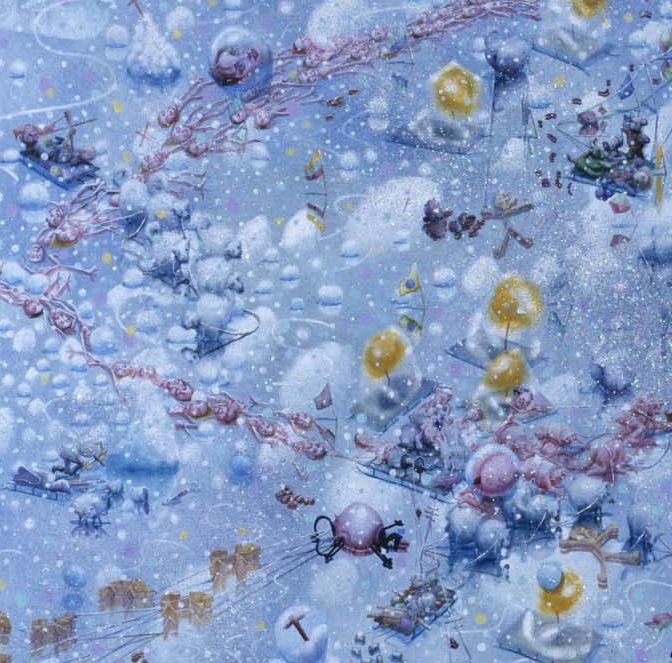
Detail 1
Detail 2
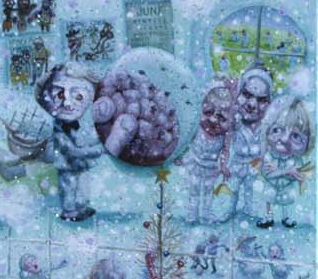
Detail 3. Hayes often uses photos to assist in capturing expressions and gestures. The young Scott here is based on a photo of the artist himself as a young child. The ballerinas are friends, and his sister, from different photographs of them as youngsters at ballet performances.
Today hardly anyone could forget yesterday

Today hardly anyone could forget yesterday by Cameron Hayes. 1996, oil on linen, 66 x 83 cms.
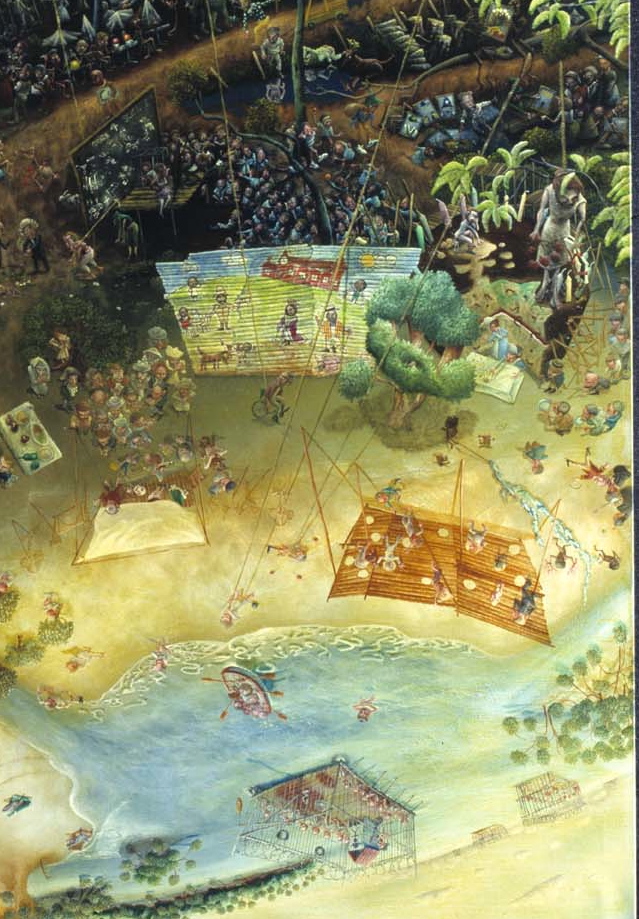
Memories take a more solid form for Australians in 1788. In fact today hardly anyone could forget yesterday. Newly landed settlers can not be bothered to spend the energy in having to re-establish their social identity in Australia. They go about merely trying to convince people of their past proven trustworthiness and charm rather than actually demonstrating it.
Dean Wallis manages his own board of testimonials clearly written for all to see, but only from the vantage point of the ocean – Europe (yesterday). Countess Beckendorff of Berlin writes “Mr Wallis proved to be most enjoyable company at parties which I attended”. W Dawson-Smith of Forthampton House writes “Mr Wallis was regarded as one of the most desirable and fashionable men of our social group”.
In England in 1788 there were no police. Everybody wanted police but the French had already thought of it and the British Parliament could not bear to be seen to be copying the French. As a result British citizens had to catch those that had stolen from them, collect the evidence against them and then try them in court. A baker who had a dollar’s worth of bread stolen from him could spend up to a week getting justice. More energy was expended in pursuing the past rather than living in the present.
In Australia the transported British legal system perpetuates a need for punishment for personal pain where victims tirelessly pursue their offender. Malnourished settlers chase a mobile court of law encircled with hanging convicts in order to throw their vegetables at them. People busily hang their perceived wrongdoers up everywhere. In Australia in 1788 wood meant for the foundations of buildings were being used to make gallows.
Cameron Hayes: “This is about a world of people who could not deal with things present without using the past to contextualize them.
When the Whites first came to Australia, they couldn’t be bothered having to re-establish their position, character, or personality all over again as they had done in England.
So most of them spent their energy convincing people that they were really charming back home rather than having to start being charming all over again here.
Most new Australians carried testimonials from people back in England, saying that they were really funny and charming, that they were the life of many parties back home, and should automatically be regarded as desirable company by anyone who meets them in Australia.”
Detail 1

Detail 2
 cameronkhayes
Officially Filed under ART CONTROVERSY
It’s official – Art Controversy! Prince, we need you to write the score!
Although it feels like it could just keep going Cameron Hayes’ show finishes tomorrow! Two further articles on the final stretch officially confirms this show has been an ART CONTROVERSY! Who would have thought? Apparently no-one for the past 8 years, but who knew? Melbourne City Council joined in on the act by informing the artist that his exhibition listing was taken down from their website ‘What’s On’ as it breached the Code of Conduct for “appropriated Indigenous ceremonial styles and clan motifs”. However, no-one from the council visited the show, they couldn’t explain how it appropriated styles or motifs, they couldn’t provide an explanation of due process, nor could they provide any recourse for rebuttal. Interesting! But at any rate, it provided further media attention, an extension of the show, and more visitors.
Read the article below!
The article appeared in Melbourne’s MX Newspaper, Friday 31st August, 2012