Mathias Ulungura captures Hajime Toyashima – 19th February 1942

Mathias Ulungura captures Hajime Toyashima – 19th February 1942, 2006, oil on linen, 167.5 x 254 cm
“The first prisoner of war captured on Australian territory was Hajime Toyashima, who crash-landed on the Tiwi Islands on the way home from bombing Darwin. He staggered to the beach where he saw lots of Tiwi women out crabbing in low tide. Hajime grabbed one of the babies left on the dry sand as a hostage. The Tiwi women just thought he was offering to carry the baby, so they returned to the community with Hajime following behind them, yelling in Japanese with a gun to the baby’s head.
When Hajime started to hear the Tiwi men, he handed the baby back to the grateful Tiwi women and ran off. Eventually he was caught by Matthias Ulungara who, before delivering him to the Whites, toured him around all the communities.
Tiwis only get bits and pieces of White culture, phrases that fall from the sky, like the leader of the tough gang who irons his Celine Dion tour T-shirt, or when a friend visited me from Germany, an old Tiwi woman wished her good luck and, “Heil, Hitler”.”
The link below takes you to an article about this true story. The first prisoner of war in Australia during WWII was captured on Melville Island by Mathias Ulungura. Click here to read the article by Catherine Schwerin.

Downed Japanese fighter aircraft A6M2, number 5349, source: Australian War Memorial. This image is in the public domain
dog torturers ?
here is another article about my show coming up in august. this is the link http://www.aboriginalartnews.com.au/2012/06/exhibition-cancelled-after-tiwi-protest.php

Cameron Hayes
Dog torturers behind the Milikapiti Clinic, 2006
oil on linen
77 1/2 x 83 1/2 inches
Photo: Hermann Feldhaus
Courtesy Ronald Feldman Fine Arts, New York
The Cambridge nursing home won the freeway mural project
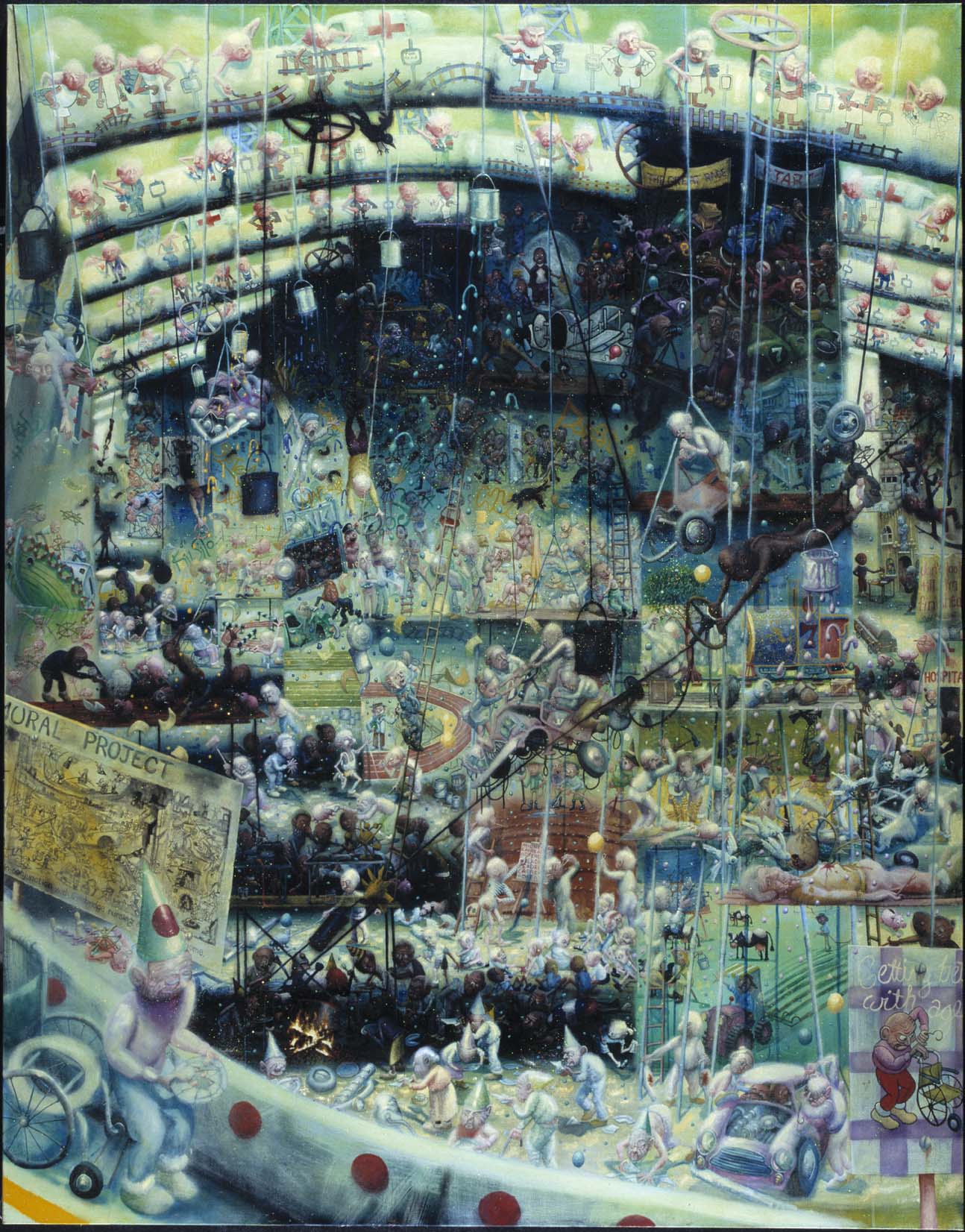
The Cambridge nursing home won the freeway mural project by Cameron Hayes. 2001-2, oil and glitter on linen, 84 x 66 inches.
The local government wanted to have a mural painted on the massive columns which hold up their new freeway. The Cambridge nursing home won the freeway mural project through their winning tender. Each resident was assigned an area of column whose image would link up with the area next to them to form one picture.
Each retiree planned only their own personal sections and started making their art without consulting one another. Despite their age it didn’t occur to any of them that other people may not fit in with their own plans, and unexpected events may impact on their grand vision.
One artist is furious to find that his Raphael-like cherubs are going to be sullied by his neighbour’s pornographic winged women, whereas the best the guy below can think of is to just paint every woman he can still remember sleeping with.
An old man has spent the remaining time of his life making a space suit and engineering a complicated plan to travel into space only to find that his wife painted only a single propeller plane. An Indian resident has painted a pantheon of Hindu gods while his Muslim neighbour painted a cart pulled by devils leading the cart into hell.
A lot of the residents are not sure how much of their remaining time to spend on something they may not see finished or could even be painted over. They decide to live in the moment and eat the painted seeds on the mural farm, smash open the piggy banks and eat the cow’s meat rather than save it for its milk.
The senile who loiter around the bottom of the freeway have broken bits of plate hoping to catch a skerrick of the cooking cow. Others try to break in to the windowless deserted car wrecks with coat hangers that have been dumped at the bottom of the freeway desperate for a feel of the steering wheel.
At the top of the freeway everybody’s different perceptions of God makes it impossible for the angels to build a cohesive rail line to heaven.
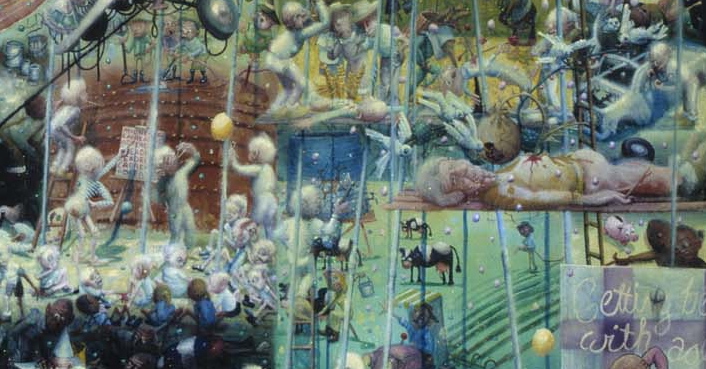
Detail 1

Detail 2
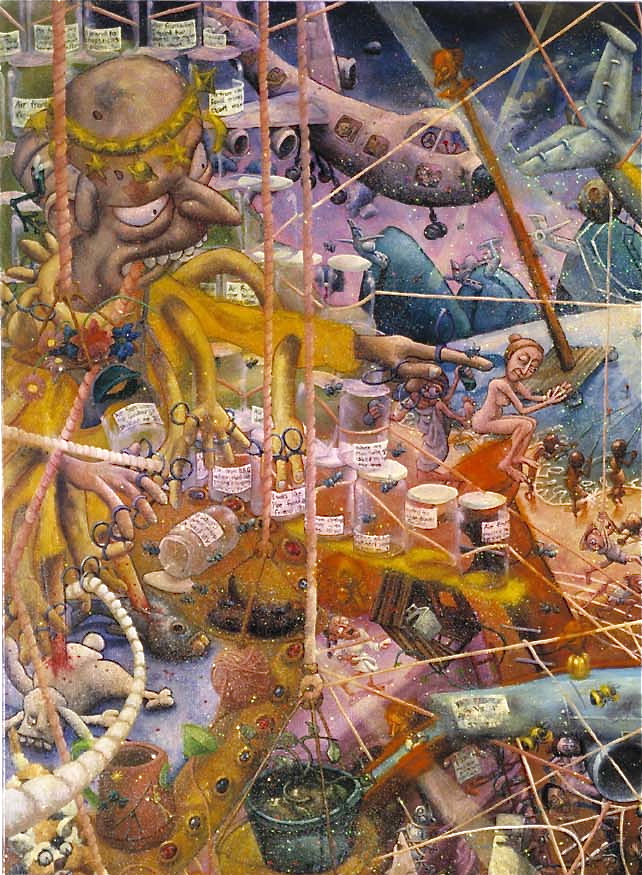
To prove he was the only God, Caligula had all the pilots killed and still made the people take their flights
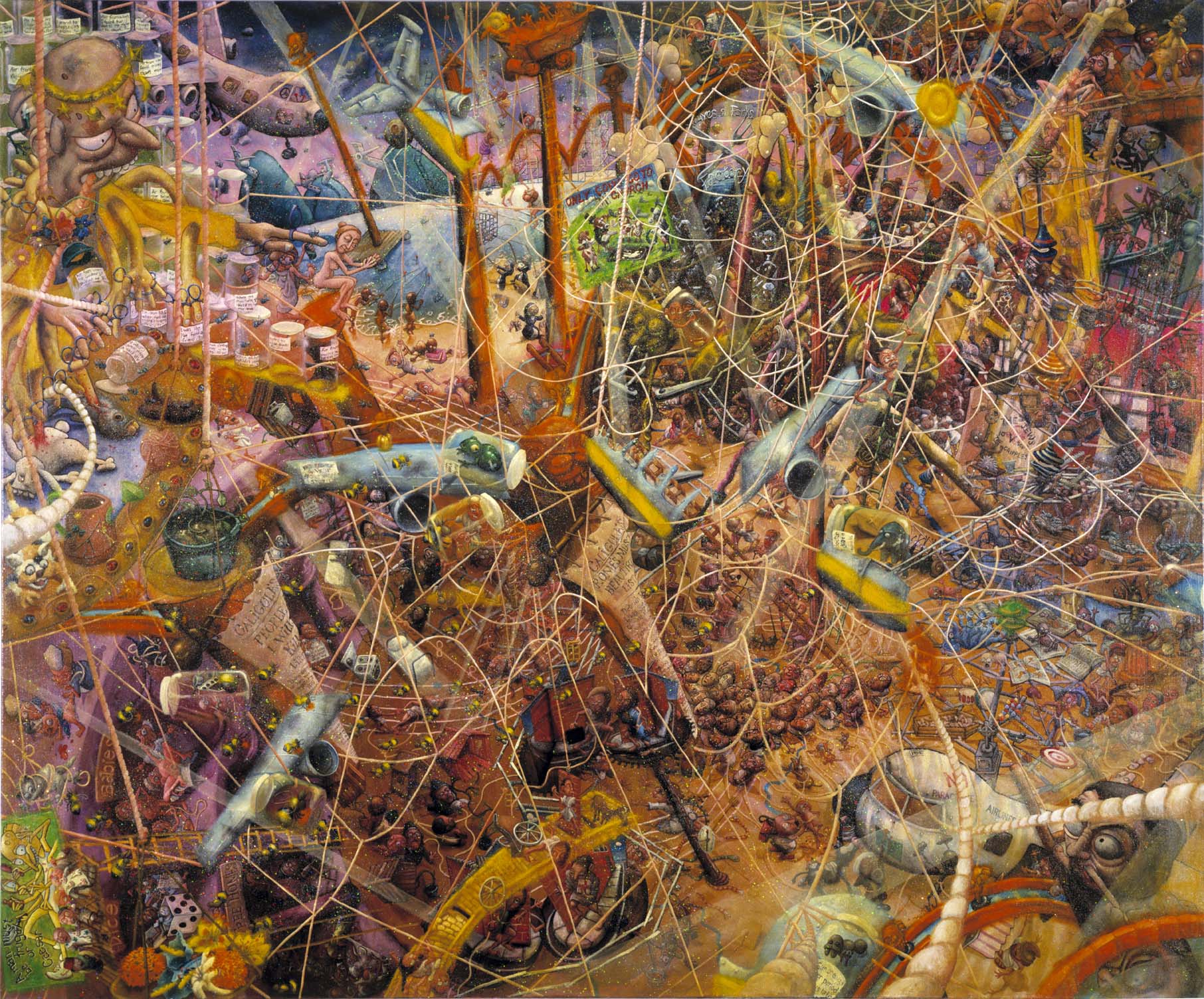
To prove he was the only God, Caligula had all the pilots killed and still made the people take their flights by Cameron Hayes. 1999, oil & glitter on linen, 60 x 72 inches.
In Ancient Rome an individual believes his own uniqueness must be elevated and recognised, and has the power to do it. The Emperor believes he is God, and to prove he was the only God, Caligula had all the pilots killed and still made the people take their flights. Not just the senators but even the army knew that Caligula had gone too far and had to be assassinated.
Caligula had already ordered that all the heads be cut off the statues of the gods and heroes in Rome and the provinces, and had them replaced with factory-produced busts of his own image. But the statue of himself he had designed for the biggest synagogue in Rome was too big, and would damage the synagogue when pushed into it. As each bureaucrat delayed the statue’s construction (knowing it would cause a public riot) they were killed.
Caligula defined God as a man who had power over every person and spent his time controlling every individual, their luck and coincidence. After Caligula had given himself everything he wanted, he then decided to tie ropes to every individual which led back to his own patio. The despot Caligula, whose personality traits have morphed him into a Mr Burns for a not so subtle contemporary personality portrait, is not limited in expression by laws or regulations but ultimately by his own lack of imagination and ability.
Cameron Hayes: “One night Caligula had a dream that he was a god. The following morning he was frustrated that nobody else had the same dream. Fortunately, Caligula had all the money and power in the world, so he was able to convince people he was a god with his display of influence on daily life, his control of luck, and his manipulation of the past and present.
What Caligula wanted most of all was to have an effect on people, be it good or bad. In pre-science Rome, Caligula knew that chance and luck played the greatest part in people’s lives, and that the older gods got all the credit for it.
Caligula knew that if he could manufacture luck and, if he could apply luck, then he would be the one god to replace the marble and bronze gods that were more famous than Caligula.”
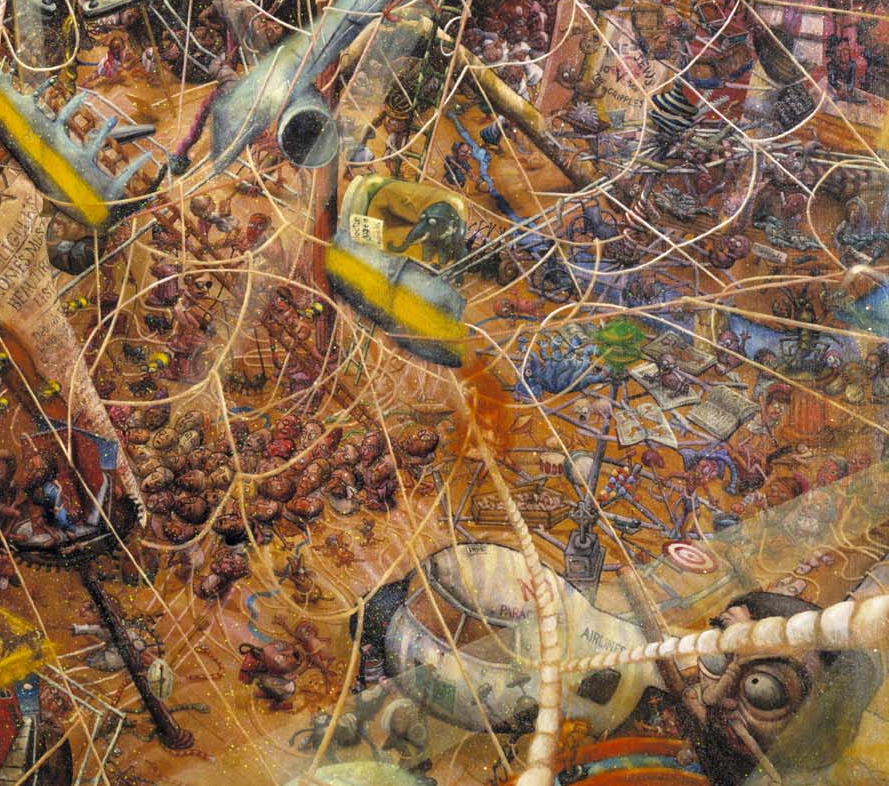
Detail 1
Detail 2
From the air we all felt sorry for the sick and starving

From the air we all felt sorry for the sick and starving by Cameron Hayes. 1997, oil on linen, 51 x 87 inches.
This is about a planeload of white people who were flying from Australia to Europe for their holidays. On the way to Europe, the plane flies over Africa, and everyone looking out of the windows of the plane felt sorry for the starving people, and wished they could help.
But then all of a sudden the plane crash-lands in the middle of the African desert amongst all of the starving Africans.
The people from the plane realize they have only a limited food supply on the plane and therefore realize they don’t want to share the plane’s food with the Africans.
So the Whites have to find ways not to feel bad or hypocritical about not sharing their food with the Africans.
While most of the Whites just refused to leave the plane, other Whites tried to frame the Africans as wasteful, litterbugs or having voluntary eating disorders. Soon the Whites start accusing other Whites of being racists or of exploiting the Africans so they look better in comparison.
When the Whites realize that it’s easier to feel good about yourself by accusing other people of being bad rather than actually doing good acts, then everyone starts accusing everyone else.

Detail
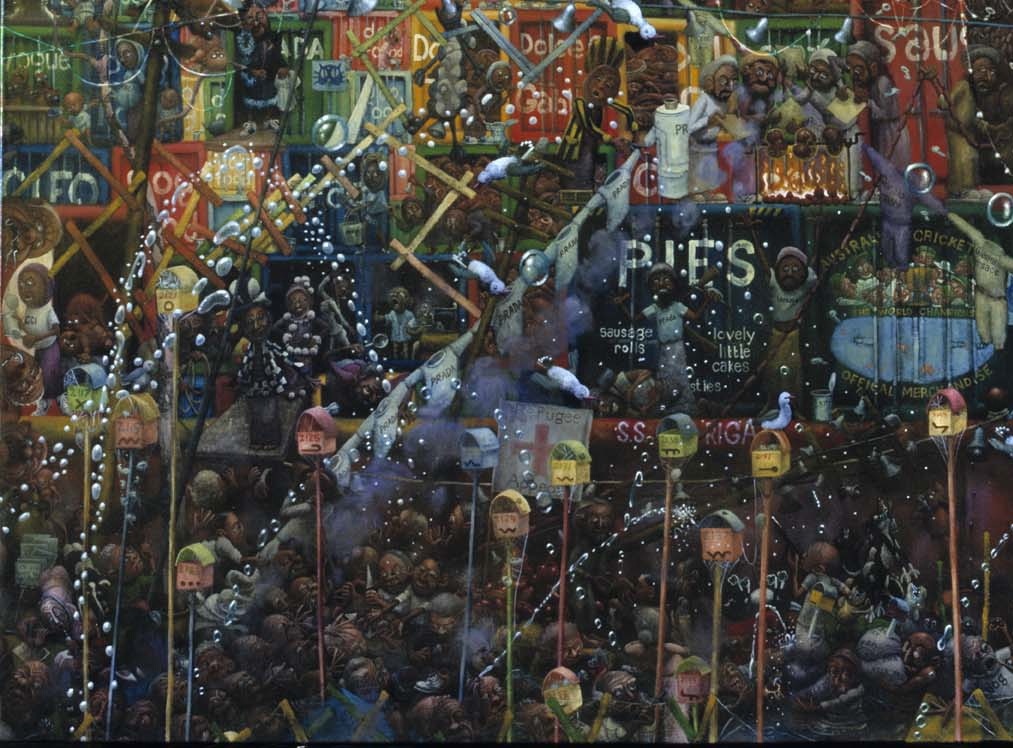
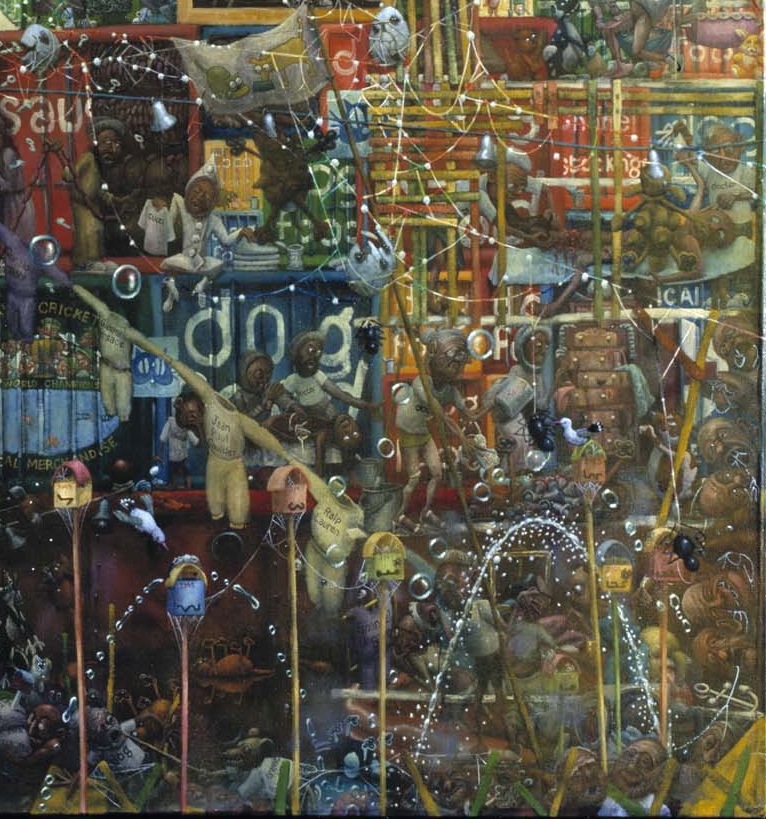
The rescued refugees had to live off what was on the container ship…The Tampa painting

The rescued refugees had to live off what was on the container ship, which because it was headed for Australia was full of fake Italian fashions and pet food by Cameron Hayes, 2002, oil on linen, 66 x 89 inches.
Later still in the year 2002 a container ship has rescued 300 refugees, including women and children, from their sinking wooden boat in the middle of the Pacific Ocean. The refugees’ boat and the container ship were both headed for Australia so the container ship continued toward this destination. However, the Australian Government does not allow the ship to dock because it does not want to accept the refugees. To complicate the situation the ship’s captain will not unload the containers unless the government takes responsibility for the refugees. So the rescued refugees had to live off what was on the container ship, which because it was headed for Australia was full of fake Italian fashions and pet food.
The importers who bought the merchandise are losing money, they fear the imported fashions will go out of fashion and the dog food will go off. So they lobby the Government and convince them to let the ship drop anchor close enough to the shore for them to negotiate with the refugees for the protection and hand over of the merchandise.
On the container ship itself, the refugees are happily adapting to their new environment. They start breaking into the containers to eat the dog food and begin wearing the fake Italian fashions with delighted aplomb. They have made comfortable homes out of the half empty containers, but the diet of pet food has begun to give them a domestic complacency.
Because of the similarities between container houses the mothers have to stay at home and with a metal spoon tap an empty pet food tin so the family can find their way home by following their pet cat. The refugees wait by cat stops to catch a cat home. The empowered and spoilt fattened cats become dangerous when their territory is threatened by new born refugee babies.
Meanwhile the importers and elderly Australian citizens have gathered on the shore. The importers are trying to convince the refugees to sell them their Italian fashions in order to recoup some of their costs. The refugee women and men model the clothes on improvised cat-walks to get the best price and to sell t-shirts with the fashion labels printed on them. The elderly Aussies are demanding some pet food for their beloved starving cats and dogs while still trying to protect their borders with garden hoses.
The scene is clouded with smoke wafting from the barbequing steaks which the refugees are blowing on to the crowd to help them sell sausages to the people on the shore. Pavlovian bells are used to retrain the elderly into welcoming rather than fearing the refugees.
Detail 1
Detail 2
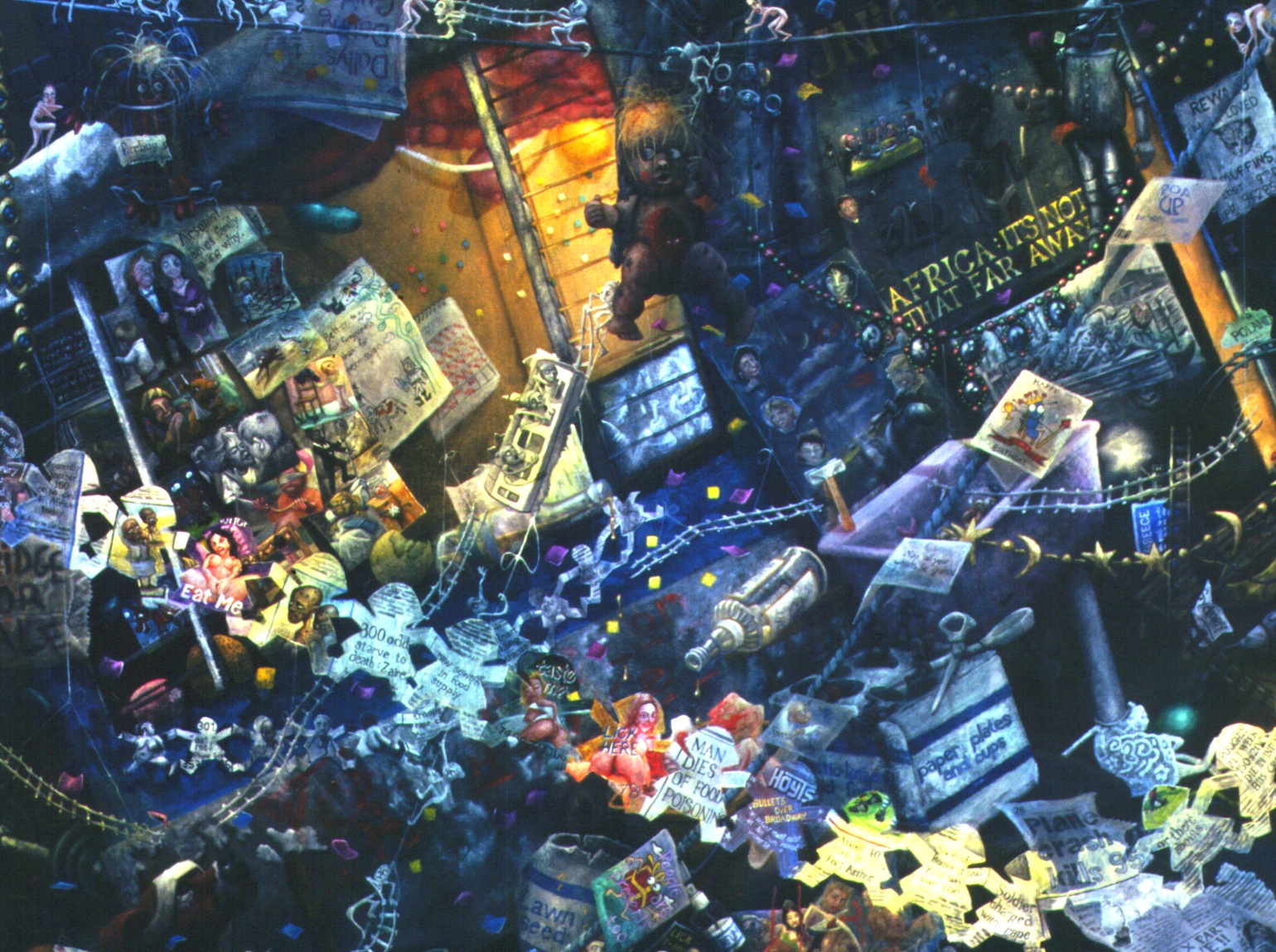
In 1977 Cameron Hooker picked up a hitchiker, 19-year old Colleen Stan…
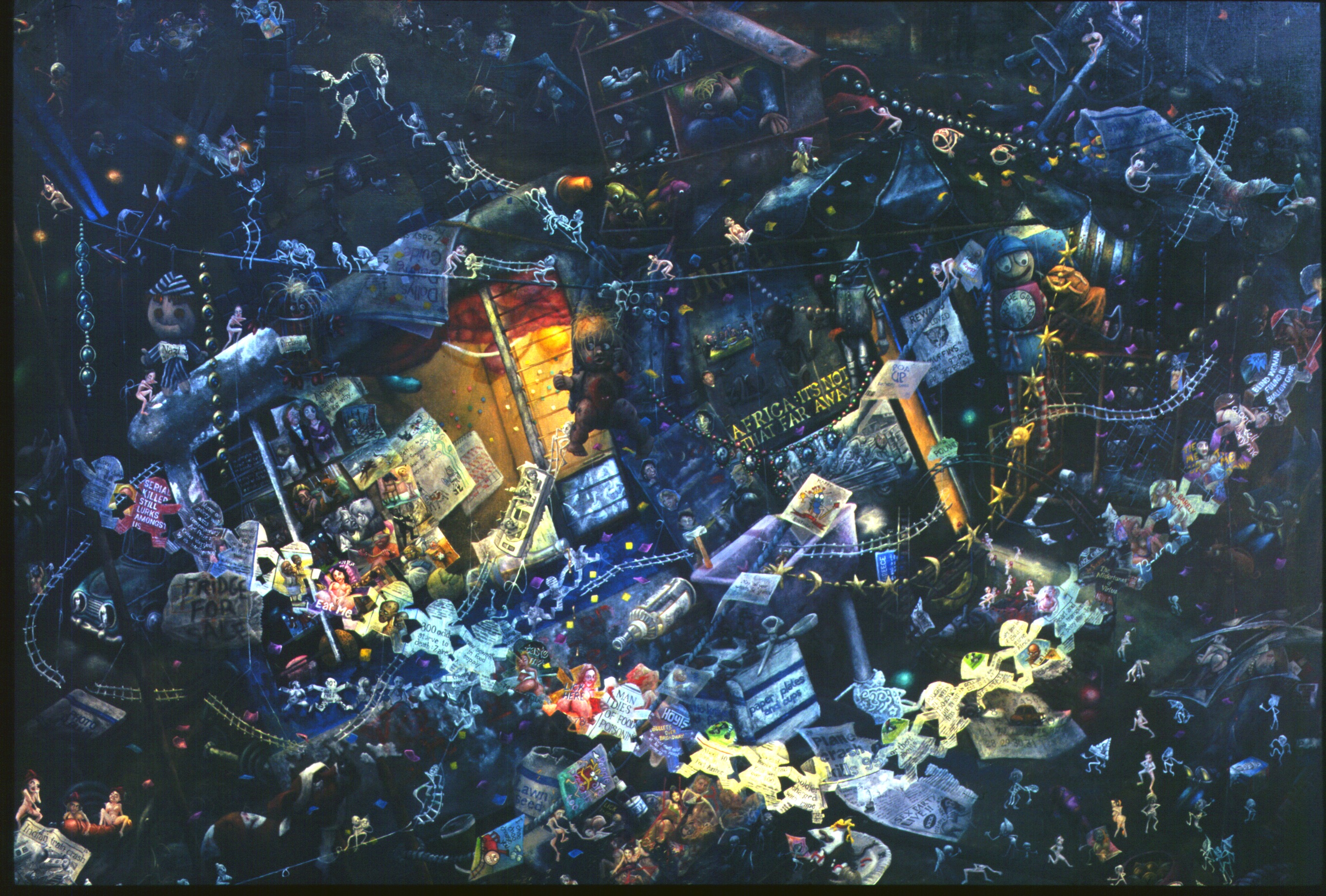
In 1977 Cameron Hooker picked up a hitchhiker, 19-year old Colleen Stan. Hooker kept Stan in a specially made rabbit hutch underneath his waterbed for seven years. She was the third woman he had tried. This is Hooker’s mobile home on his 27th birthday. by Cameron Hayes. 1998, oil on linen, 66 x 78 inches.
The bedroom of the 27-year old Cameron Hooker reveals a personal history, with books, pets, whiteboards, newspapers, clothes all devices which also build a portrait of a personality.
Over many years his masturbatory talent has developed to the level of making real images of his memory and characters from his pornographic paraphernalia. Hooker has the power to visualise his own fantasies to a point where they come to life and crawl all over the room. But, as fantasy is elevated to the level of reality, reality is relegated to the level of fantasy. A train crash in India has killed hundreds. Thousands of African children starve to death. A girl missing is found dead.
He has cut a chain of paper dolls from a newspaper where serial killers hold hands with victims of war, who hold hands with spread legged women, with a plane crash of 99, with a rapist soldier, with movie ads, with oral sex, murder, football scores, they are all the same linked chain. They are all of equal value.
In 1977 Cameron Hooker picked up a hitchhiker, 19 year old Colleen Stan. Hooker kept Stan in a specially made rabbit hutch underneath his waterbed for seven years. She was the third woman he had tried. This is Hooker’s mobile home on his 27th birthday.
Colleen lived with Hooker and his wife Janice from 1977 to 1980 sleeping in a 3-foot by 3-foot box in which she had to fold herself into a foetal position to fit. Hooker let her out for walks inside the caravan with a specially built head box on made of heavy wood, which fitted tightly around her head, but was very difficult to see out of.
By 1980 Colleen proved to be so obedient that Hooker rewarded her by making her a much more spacious specially built rabbit hutch of chicken wire and wood, hidden underneath his waterbed.
After seven years Colleen Stan decided to escape, but still it took her two years before she reported her story to the police. During those two years a worried Colleen rang Hooker regularly to make sure he was eating right and that his clothes were being cleaned. Both Colleen and his wife Janice said that they loved Hooker and claimed to understand him.
Cameron Hayes: “Colleen Stan and Janice Hooker – who lived with Hooker and Stan during the 7 years – understood Hooker and both claimed to have loved him. In this picture I have tried to understand and describe Hooker.”
Detail.
Boyd made a film about some of my Tiwi work
Boyd Hicklin made a film in 2006 about some of my Tiwi work. here it is
 cameronkhayes
The Approach to Cameron Hayes – 14 Kurdish refugees…
here is an article my friend wrote about my Milikapiti works. the show is on at Dark Horse Experiment at 110 franklin st in Melbourne from 1st august until september 2.
this is the article here – ARTICLE
this is a painting from the show.
14 Kurdish refugees land in Milikapiti and ask, “is this Australia?” – 4th November 2003, 2012, oil on linen, 61 x 81 cm
on the 4th. of november 2003 14 kurdish refugees landed on the beach at milikapiti. one of the kurds yelled out from the boat ‘IS THIS AUSTRALIA ‘. the tiwis on the shore were not sure because the australian government was disowning the bits of itself that could be used to help people like the refugees.
this is an article from SMH about this story
Quote from marielle’s article about this work:
“The latter work referencing the sinister use of marketing in politics and the media. Based on a true story, a group of refugees were spotted on a vessel in the bay at Milikapiti. The conservative Howard Government of the time did a fantastic job of instilling a fear and hatred campaign of refugees through the media, basically branding them as potential terrorists and possible carriers of unknown diseases. It worked. So pervasive was this strategic political message that it even reached across the nation from capital cities to remote small communities. So here we have asylum seekers in the guise of The Raft of the Medusa, instead of ragged cloth they are waving brand name t-shirts representing our new dominant culture – the well marketed Brand. Would they have more success by appealing, not to empathetic fellow people, not to other displaced victims, but to those who like the same brands – who do you identify with? Are you Nike or more of a Burberry? Are you Apple or PC? Are you Right or Left?”