STRUGGLE SESSION
AUSTRALIAN GALLERIES MAY 30 – JUNE 17

Struggle sessions evolved from ideals of criticism and more
importantly self-criticism popular amongst Russian communists in
the 1920’s. Chinese communists were slow to take up struggle
sessions as they conflicted with the more traditional Chinese ideal of
“saving face”. Later during the Land Reform Campaign! struggle
sessions took off as the people needed to demonise and get angry at
the people they were taking land from. Peasants were encouraged to
accuse land owners of all sorts of crimes and call them all sorts of
names in struggle sessions promoted as “speak bitterness “sessions
and “give utterance to grief “sessions.
Struggle sessions and then denunciation rallies filled the gap
otherwise filled by the news and then social media. People were at
first bonded by the spectacle of someone else being humiliated in a
public setting and then protected by their ability to name some else
to be humiliated, defamed and beaten – in a public setting.
Constantly accusing was the best form of protection against being
accused/struggled.

The process of avoiding being accused started with writing
accusations about people in your town, that you barely knew, on big
poster paper and pasting it on public buildings or hanging them from
the loud speakers that screamed party slogans from street corners.
With the support of other like-minded people, you then organise a
struggle session where you could be seen accusing your target
person of the impossibility of not avoiding one category of the
impossible to remember-never ending list – of anti-party behaviours.
One of the few powers available to the peasants was the most
powerful – the power to transform through judgement. Struggle
sessions gave the peasants the chance to turn a rich landlord into a
“capitalist roader”, “class enemy “or “counter revolutionary”. A
persecuting government official could be transformed into “a
rightist”, “a western spy” or even a “Krushchev”. Most seductively
you could turn a stranger into someone of whom you know
everything important there is to know.

Committed judgement doesn’t end at a funeral. In order to feel
comfortable in the present it is important to judge and then label the
past. This sets the past in place and stops it from coming up from
behind contradicting your present. We have to re-label past
relationships and de-friend them on facebook and so the natural
logic of the struggle session was to transform the people of the past
through judgement to stop them humiliating and contradicting the
people of the present.
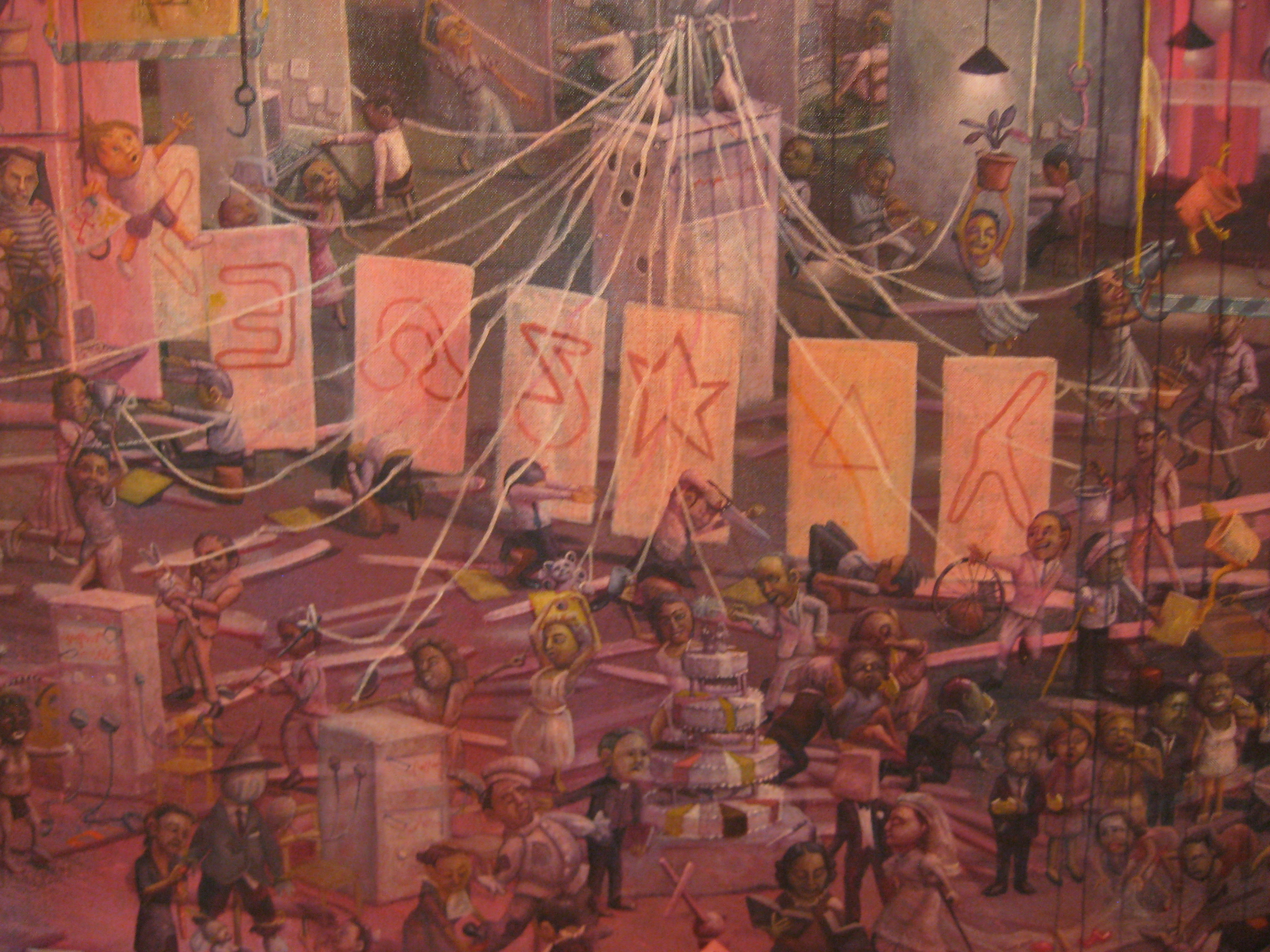
When you lie you lose a bit of yourself and replace it with a bit of everyone else AUSTRALIAN GALLERIES SYDNEY SEPT. 3 – 22

WHEN WE LIE WE LOOSE A BIT OF OURSELVES AND REPLACE IT WITH EVERYONE ELSE
At a funeral it is the custom to lie about the dead person and his/her life to the extent it’s no longer possible to identify the body. Even after death we live a lie.

Cameron Hayes
When You Lie You Loose a Bit of Yourself and Replace it with a Bit of Everyone Else, 2016
oil on linen
60 x 72 inches
photo: Vince Ruvolo
courtesy the artist and Ronald Felmdan Gallery, New York
.
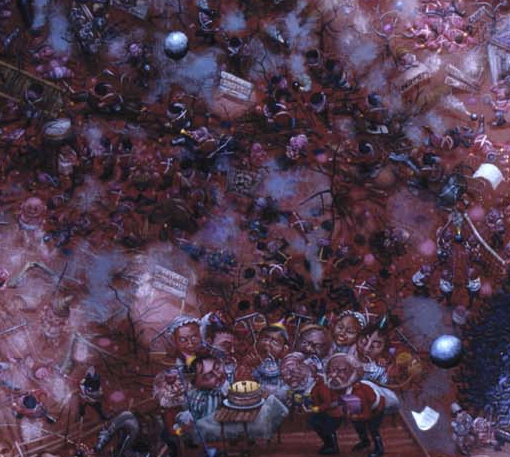
A woman reads from a prepared eulogy- nothing lies like a eulogy – the mourners listening to it are trying to make sense of its parts and are trying to re-assemble the dead body is like trying to put together an IKEA table but they are confused by the contradictions and implausibility of the life they were hearing about and the life they thought they knew . Above them a couple sit exasperated holding an allen key and IKEA directions to a table with pieces that don’t look like they belong to a table.


In the centre of the picture there is a marriage cake, both bride and groom have already taken pieces out of the wedding cake and replaced the pieces with other bits of cheaper cake to hide their theft. For the sake of the wedding the couple walk down the isle already missing pieces of themselves in an attempt to accommodate their partner. The bride’s leg is replaced by a bike wheel her arm is a crutch, the grooms head a rubbish bag. The bridal gown’s train catches bits of the couple as they walk and two groomsmen trail behind with wheelbarrows to collect and reattach the couples missing bits

marriage cake

Some people lie so much that they become empty sacks – scarecrows. Their loved ones hunt around with lie detectors trying to find the lost bits of them in an attempt to refill real parts of them back into life. A giant public lie detector is used by many desperate people who dance around the lie detector in adoration with personal objects wired to it that they know wont lie to them ; pet rabbit, pot plant, golf club…ect..

A man with his pants down is thrown out of what looks like a public toilet, only to realize the cubicals are selling computers and the toilets are computers. Dogs are also fooled into thinking what looks like a park is a park- it is really a plant shop. A pet shop is made to look like a police station, market research is made to look like a school and a bed and furniture shop is made to look like a hospital. The beauty shop looks like a church with statues of Mary and Jesus replaced with six packed models .Art museums are fronts for gift shops. Even buildings are actively lying.
Loose bits of people are clogging up the streets and garbage men use people’s empty outsides as bin bags to clean up the mess, they throw the body bags into the dump truck and take the bits of people to the bucket factory. At the bucket factory bits of people are melted into plastic and moulded into empty plastic buckets so they can re-roam the streets waiting to be filled with lies and deceit. People are born as originals and die as copies


“By a lie a man annihilates his dignity as a man” – Kant. At the job interview applicants are seated in front of giant posters of shapes they are expected to fit into ,they are given the waiting time to self-mutilate so as to fit the required shapes they loose and gain body parts while trying not to drop the CV’s they brought from the lobby vending machines. Those long term unemployed have no uninjured parts of their body left and only their heads emerge from their bandaged bodies rolled around on wheelchairs

“There is in the world only the choice between loneliness and vulgarity” – Schopenhauer .In the background cars are dressed up as aeroplanes – the lies we tell ourselves about the things we are going to do. The cars drive to the ethnic restaurants to who’s countries we will lie about going to and then to films who’s books we will lie about reading. Also in the background are cardboard skyscrapers populated by a single angry man with a computer who tells himself 1. That he has something important to say and 2. That everyone will agree with him if only they understood him. These skyscrapers have names like ; The Institute of… and The Coalition for …. and The Committee for…. and The People Against…..
review by robert shuster in the village voice 2011
i am posting some old reviews and articles. this review written by robert shuster was in the village voice 2011 and is about my exhibition at ronald feldman gallery that year.
CLICK THIS TO READ THE ARTICLE
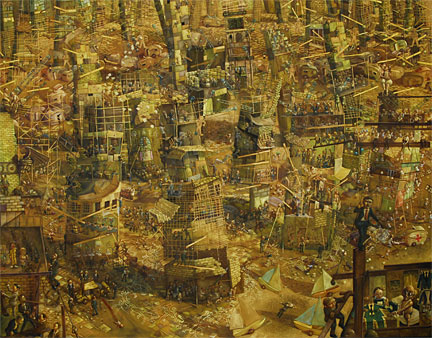
Orphanages make the best skyscrapers,
2011
oil on linen
78 x 100 inches
2011 show on huffington post
i am posting some old reviews and articles. this link was on huffington post and shows my paintings from my exhibition at ronald feldman gallery that year.
CLICK THIS TO READ THE ARTICLE

what happens when pretend politicians pretend to be terrorists by cameron hayes, 2011, oil on linen, 78 x 100 inches
Article by Evan Maloney from 2006
i am posting some old reviews and articles. this one was on news.com written by evan maloney, about my milikapiti show which was shown in melbourne and new york and then melbourne again with more things.
CLICK THIS TO READ THE ARTICLE

install shot from Ronald Feldman Gallery New York
Article by Evan Maloney from 2004
i am posting some old reviews and articles. this one was in the Cordite review written by evan maloney,
CLICK THIS TO READ THE ARTICLE

The rescued refugees had to live off what was on the container ship, which because it was headed for Australia was full of fake Italian fashions and pet food by Cameron Hayes, 2002, oil on linen, 66 x 89 inches.
Review by Grace Glueck, NY Times from 2004
i am posting some old reviews and articles. this one is about my show in new york at Ronald Feldman Gallery. . it was in the new york times.
CLICK THIS TO READ THE ARTICLE
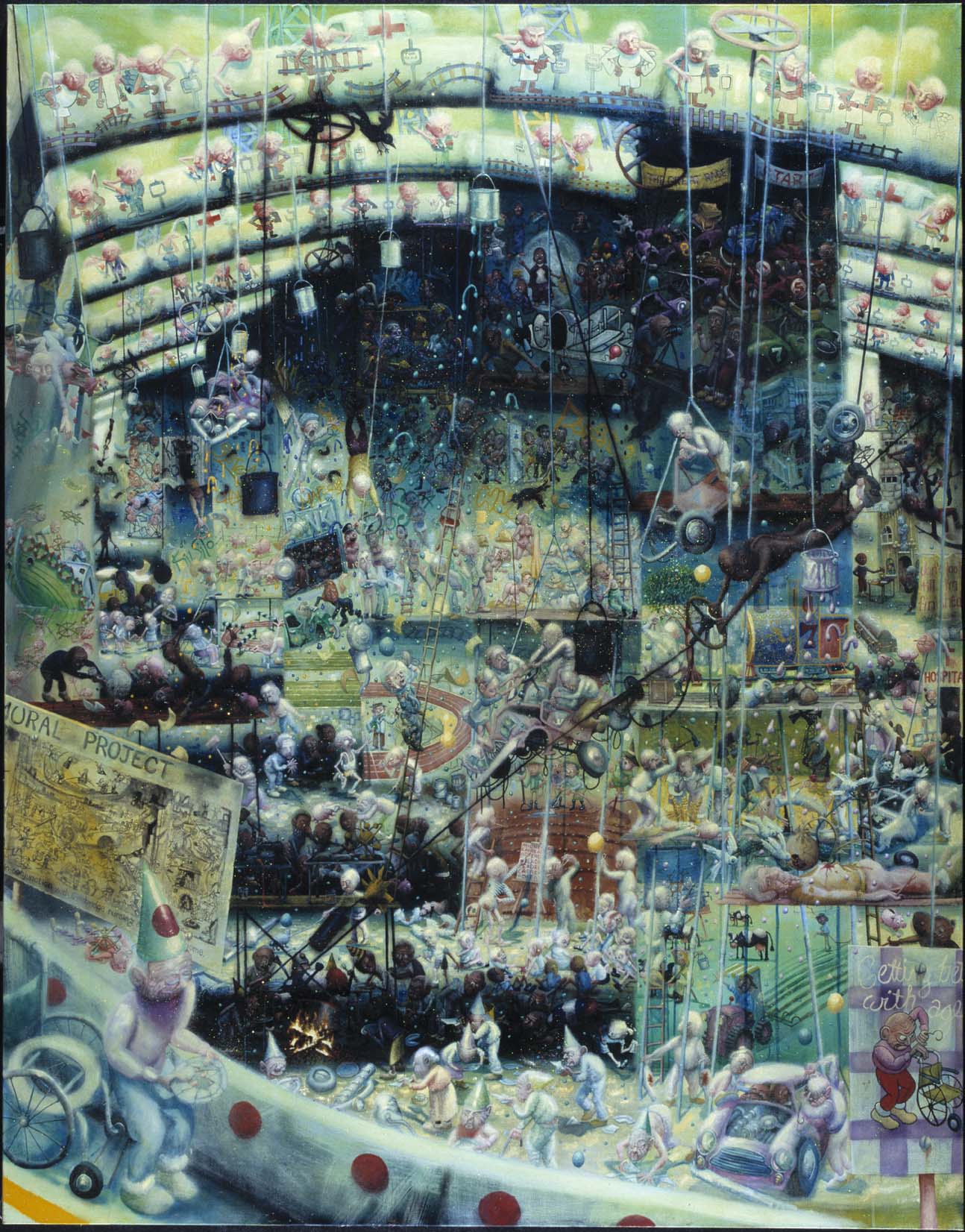
The Cambridge nursing home won the freeway mural project by Cameron Hayes. 2001-2, oil and glitter on linen, 84 x 66 inches.
Review by Robert Nelson from 2004
i am posting some old reviews and articles. this one is about my show in 2004, i put it up in melbourne for people here to see before they were sent to my gallery for my show in new york. so robert got to see it and wrote about it.
CLICK THIS TO READ THE ARTICLE
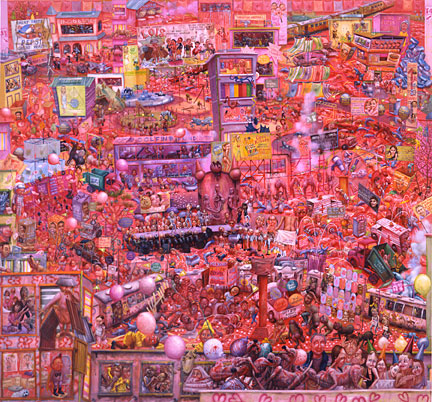
Before there were laws for corporate
pedophilia, 2003
oil on linen
84 x 78 inches
During the looting of the Kerch Museum babies traded with ancient coins
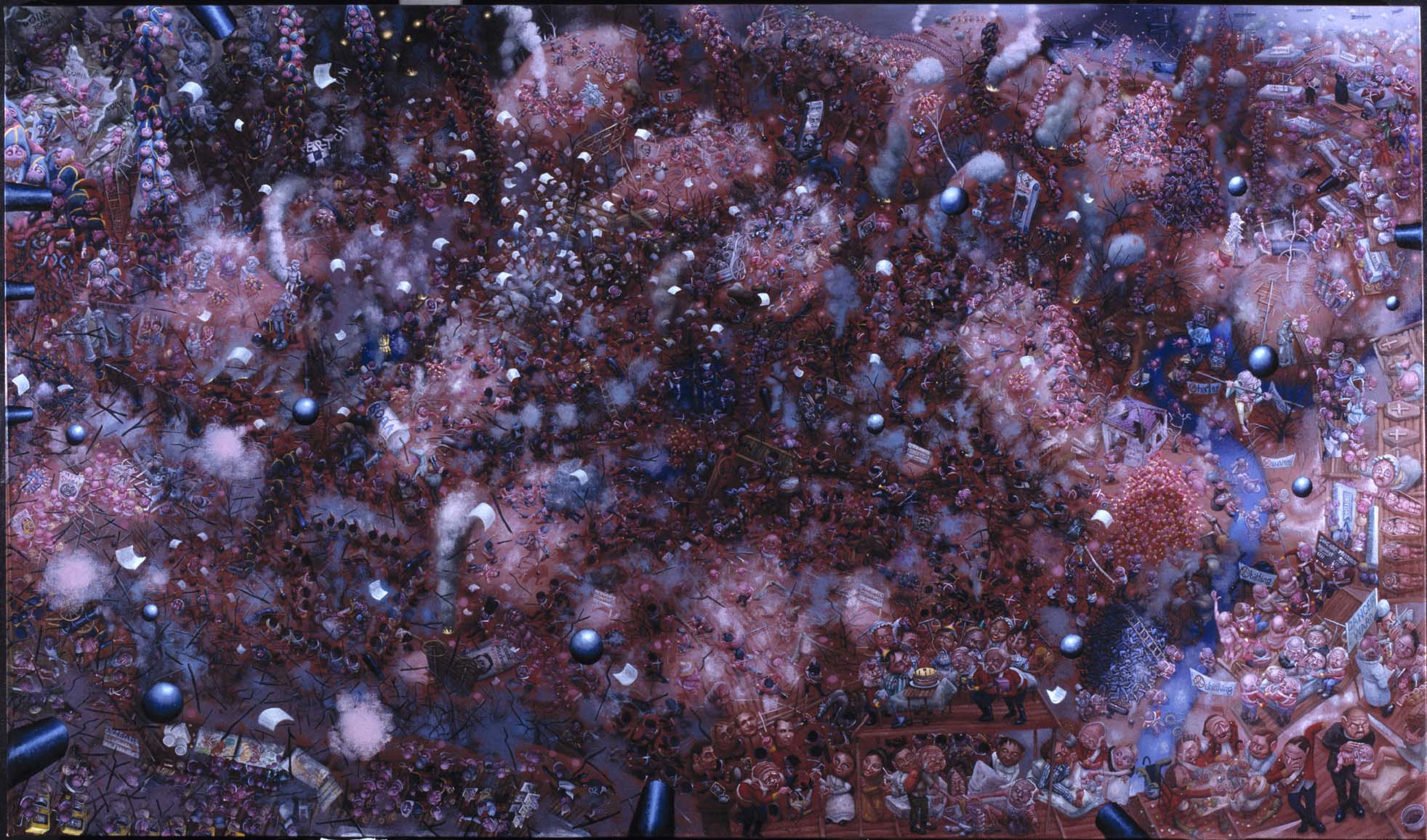
During the looting of the Kerch Museum babies traded with ancient coins by Cameron Hayes, 2002-3, oil on linen, 65 x 100 inches.
Time does not beget wisdom. During the Crimean War the Kerch Museum housed one of the world’s best collections of ancient artefacts. The soldiers of the Russian, Turkish, English and French armies did not wait until the battle was over to loot and destroy the contents of the museum. The battlefield became littered with stolen and abandoned priceless ancient vases, statue rubble, marble arms and legs, historic maps, public records and fragile shields and delicate spears.
The average age of a general in the Crimean war was 77. It was the last war in which inexperienced old Englishmen without military talent or intelligence could buy control of an army of young men. Generals directed a battle from a safe distance and insisted on living a civilised lifestyle despite being on a battlefield. They drank and washed from the top of every stream whereas the young soldiers got Cholera and Typhoid from drinking water from the bottom of the stream. The young men were forever soiling their pants and coughing up phlegm. They became deaf from the close range of the canons, and crippled by the activity of battle, appalling sleeping conditions and worst medical services than the older generals.
The old men were relaxed and invigorated by battle, comforted with the knowledge that in war how old you are is measured not by how far you are from birth but by how close you are to death. So in this environment all the young soldiers were in fact much older than they.
During the looting of the Kerch Museum babies traded with ancient coins, and many of the local children have loaded themselves with looted Hellenistic Period coins. They are finding that despite their wealth they are being ignored at the antique auctions, turned away from the all-you-can-eats and the slot machines merely fire back their coins quite hard and at shin level height. Most tragically their money will not buy them the medical attention, which is reserved only for the old generals.
Some old generals have tied strings of babies around the vegetable gardens to protect them from bombs and erected baby scarecrows. Other generals have tied babies to the front of their horses like fluffy dice. A bomb has landed and exploded in the local fortune teller’s shop, sending thousands of fortunes flying into the air. They are chased by giddy old men through the battlefield and across minefields, while a palm reader has set up shop to service distraught wives who collect blown-off hands and arms in search of information about their husbands.
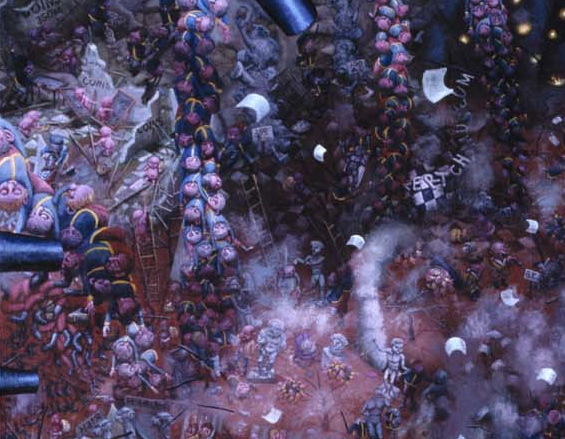
Detail 1
Detail 2

Detail 3
 cameronkhayes
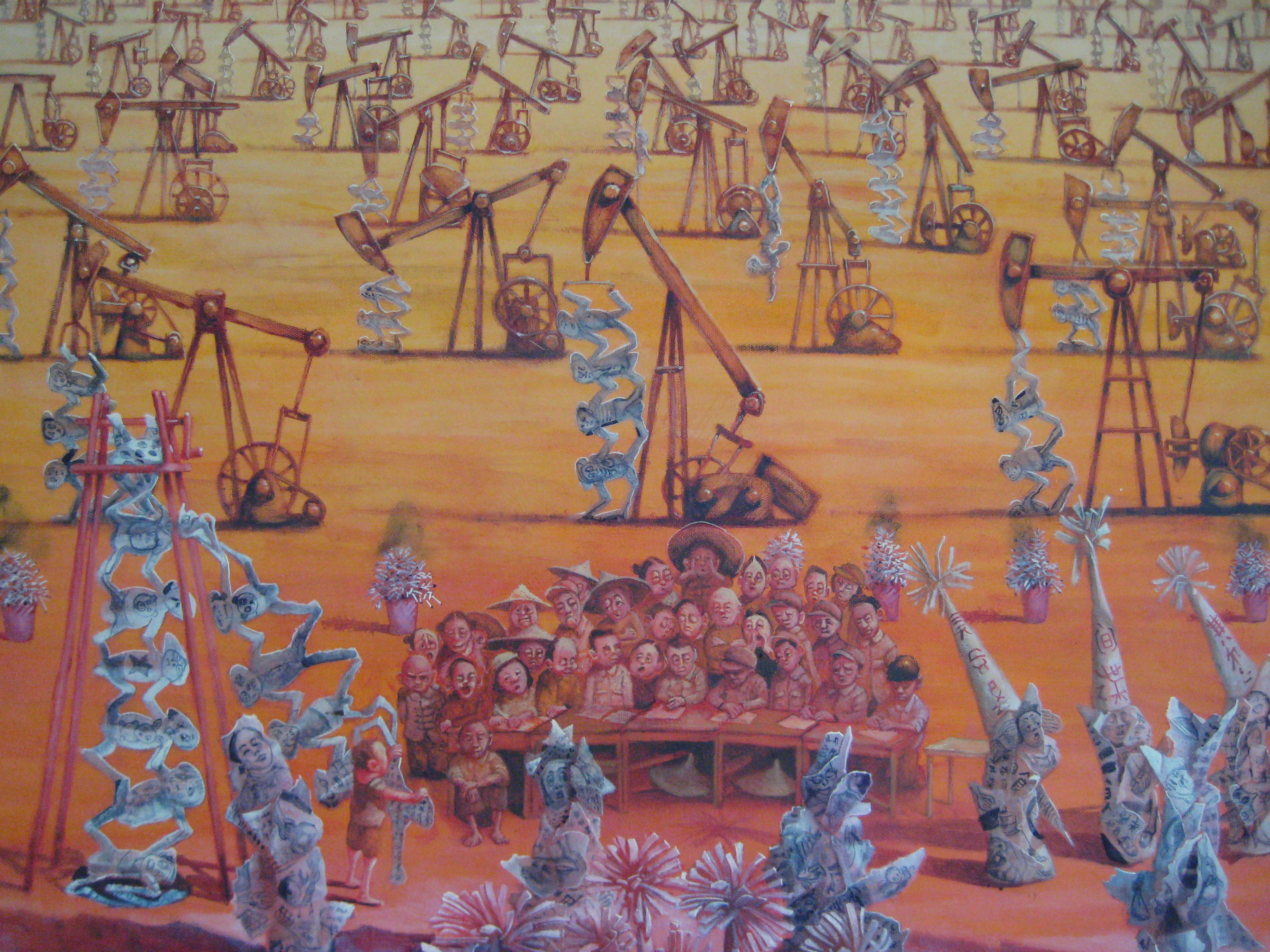
“And Mao said let the fish be for the heavens, let the birds be for the earth and let the people be everywhere and nowhere. And Mao saw that it was good…
Australian Galleries, Melbourne, opening May 30 6-8pm artist’s talk Saturday 3 June 2pm, show finishes 17 June
AND MAO SAID….
A narcissist experiences the world in crime sized bits – crimes against his or her omnipotence. For chairman Mao and later and alongside Madame Mao the cultural revolution was an attempt at crushing a crime spree.
RICE SACKS
Being just one in the biggest population in the world and your generation just the latest in an infinite number of proceeding more interesting generations leaves you with living a life of constant humiliation and envitability. For the people of pre-cultural revolution personal significance was an impossibility. The cultural revolution offered the possibility that their place, race and time was the most – potentially the only time, race and place of significance. Rice in general being one of the most important things in the world and world history but a single grain being the most insignifant of objects – rice became a symbol of the power of shared common things, ahistorical essential things, venerating the always overlooked things made the poor people who owned them feel at first special then as always follows – superior. People first dressed in clothes made of rice sacks then inevitably they just wore rice sacks.
DESTRUCTION WITHOUT REPLACEMENT
In massive populations there is the fear of disappearing – in third world politics there is the fear of being disappeared. Mao was shocked by the way his comrade Stalin was disappeared after Stalin’s death during the 50’s and 60’s in Russia by Khrushchev and his followers. Mao didn’t just see Khrushchevs in his government but he saw them in every member of his enourmous population,and in every statue of a past great ,every symbol of religion or europeanism and in every page of historical and creative record. The steam rolling and cementing over of cemeteries, the burning of university libraries and smashing of churches was for Mao and the people the ultimate narcissist fantasy of destruction without replacement.
GENESIS 1. AND GOD SAID….
And God said let the birds be for the sky….and God said let the fishes be for the waters and God saw that it was good. And God said Let us make man in our own image, after our own likeness….and God saw that it was good.
Mao and his followers could change the course of rivers, the height of mountains and even the populations of mice, mosquitos and certain types of sparrows. Because they destroyed all the ornamental fish ponds in China, Mao’s red guards had to pile up plastic bags half filled with water and gold fish until they reached the sky. Mao’s war on sparrows meant that the land was covered in birds and Mao’s cult of personality saw everyone dress, talk, think and look like one person. The people could turn historic iron gates into frying pans and pianos into work benches and paintings into floor mats and university professors into cleaners. Street names, shop names and people’s names were no longer set by an alienating past and protected by a yet to be determined future. Everything would belong to the now and the here.
TRAFFIC LIGHTS WITHOUT INTERSECTIONS
By breaking away from his communist party and criticing and encouraging criticism of it, Mao exposed the great swindle of western democracy that of giving the people the choice of two of the same thing. During the cultural revolution and beyond, Mao created divisions in the party to give the people a sense of choice but when the people share a common one direction, choice or symbols of choice ; art religion ,fashion ect… became merely decorations like traffic lights on a road that has no intersections.
TERRACOTTA WARRIORS
The cultural revolution was able in some part to turn the public and historical into the private and contemporary. The shared public humiliation of the previous two hundred years of bulling by foreign nations had the Chinese looking for a completely new way of seeing themselves and the world. The farce or tradgedy of trying to solve systematic problems with biographical solutions was one of the defining qualities of the cultural revolution. People high on the power to change the world to meet their needs turned zoos into supermarkets , aquariums into fish markets, farms into factories and people into tools..The fear of personal impotence was solved by the mass torture of exotic animals. Visitors to the art museums had their portraits painted over the heads of historically important works some not taking of their rice sacks covering their heads. The work done by talentless but well trained party artists.