The race to be the first celebrity: Jack The Ripper versus The Elephant Man – Australian Galleries, Sydney 3-22 Sept.
Cameron Hayes
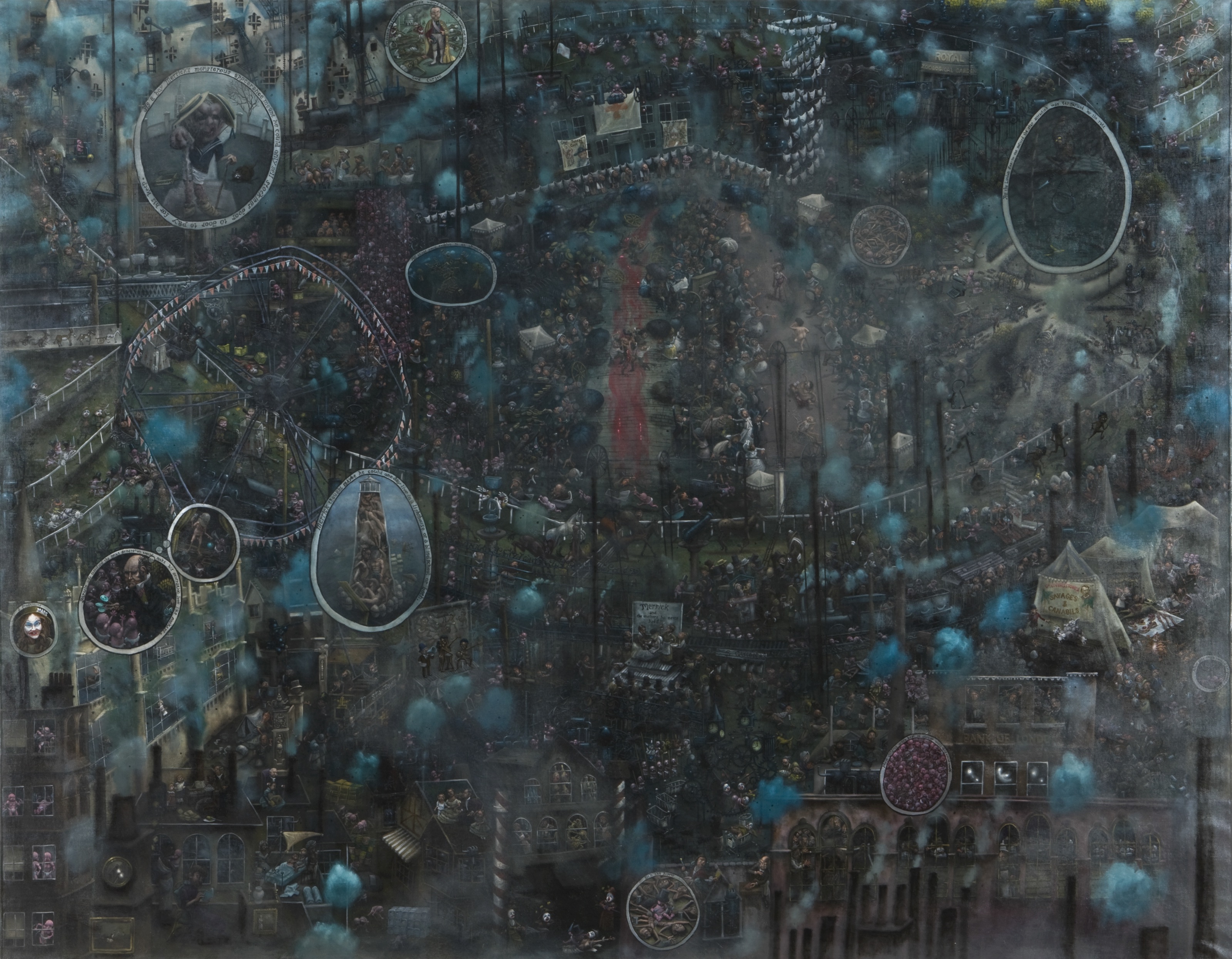
The Race to Be the First Celebrity: Jack the Ripper versus the Elephant Man, 2011
Oil on linen
78 x 100 inches
Photo: Bill Orcutt
Courtesy Ronald Feldman Fine Arts, New York
The race to be the first celebrity: Jack The Ripper versus The Elephant Man
The 1880s: Darwin had convinced most people in England that the process of
evolution meant the next generation would make their generation look like monkeys
in comparison. To prove their status and relevance, people in the 1880s were
determined to celebrate regressive rather than progressive character traits. They
wanted to celebrate the aspects of people that they considered backward and
regressive. People wanted to promote qualities in their fellow man that were
humiliating and anti-evolutionary, to inhibit the feeling of being surpassed


The local government replaced all the statues of heroes with statues of toilets, irons,
and vacuum cleaners. Everything inspirational was being replaced with the
acceptance of the debilitating filth of human mediocrity. In the afternoon, people lined
up along the driveway of the mental home to applaud the new patients forcibly being
dragged in, as well as outside the jails to view the violent criminals. They also line up
along the hospital driveway to watch those maimed in factory accidents crawl to the
hospital door. The trail of blood they left behind started the tradition of the red carpet
for celebrity arrivals.

Many formerly famous people have to make their achievements even more
spectacular to keep up with the new fashion of celebrities. Dr. Livingstone tried to
convince his audience that everybody and every animal he met on his adventures
were cannibals. He did this by starving baby animals and then stuffing the mother’s
skins with fresh meat. Soon lying and pantomime replaced discussion and history.

But the more emotionally and physically disabled they were, the more their celebrity status became
invincible. As more and more machines of the industrial age threateningly came torepresent to people that they were becoming evolutionarily obsolete, people became more attracted to those who were previously outcast: prostitutes, the exotic other, mental patients, criminals, and the physically impaired. The greatest celebrities of the age had to involve a combination of crime, mental illness, sin and prostitution: like the crime and mental illness of Jack the Ripper and the physical deformity and “nativeness” (mother squashed by an elephant) of The Elephant Man.

As a child the Elephant man was thought so shockingly grotesque that the only job
he was suited for was selling women’s stockings door to door.

A theme park called “The Elephant Man’s Mother” celebrated how Joseph Merrick
suffered without his mother’s milk (nature): children could buy elephant man masks,
head sacks and trinkets at the gift shop.

Great thinkers and achievers made people feel inadequate like old school friends
who have made it big. People blocked them out by filling their minds with the lives of
the needy and emotionally retarded: Karl Stefanovic, Alan Jones, Kardashians.
Images of great art were replaced by Instagram pics of restaurant meals.
Philosophical proverbs and heroic mottos were replaced by tweets about – well –
other tweets. Prostitutes (then) and skinny models (now) along with sexually ambigous radio hosts are symbols of nonreproduction, and, along with criminals, are celebrated as an affront to the next
generation to the certainty of evolution.


Ugliness becomes the new trend with dog baiting and talkback radio, adults toileting
and fighting in the streets to affirm their human / non-robot status. The ultimate
machine of the age – the clock – torments people by reminding them of an evolved
future of which they will not be part of and obliterating the past which they felt
superior to.

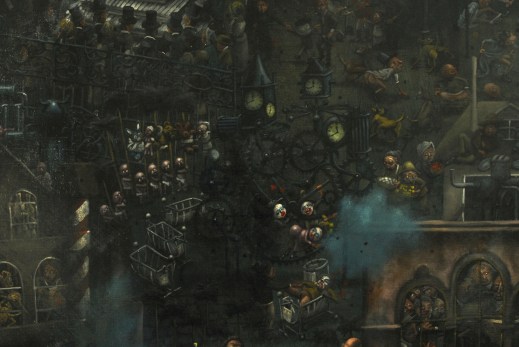
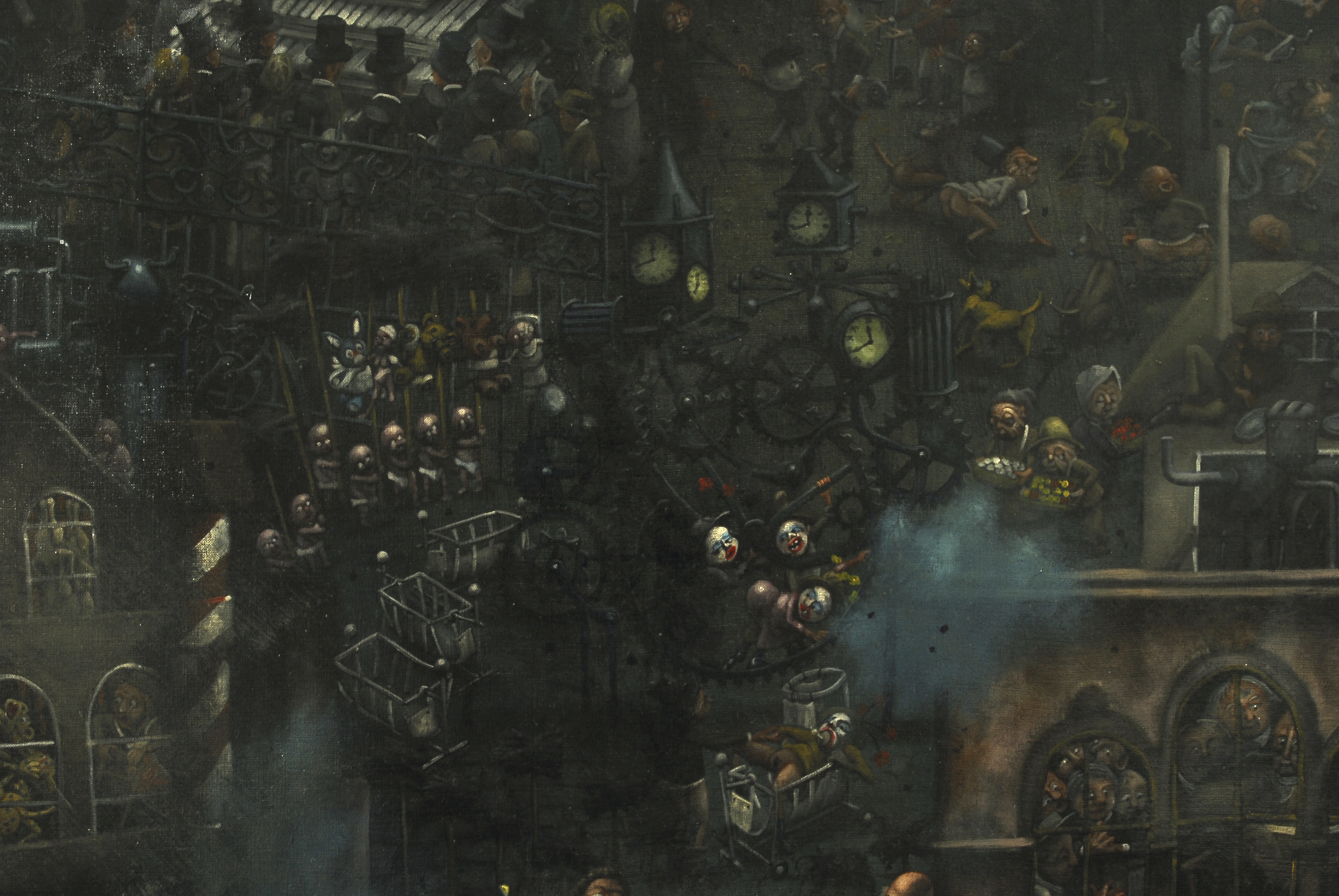
Darwin’s theory of evolution means babies are the masters of the next generation,
exploiting the adults’ fear that they would have to mutate to survive. Babies are
destroying the old London by driving steam train tracks through old buildings and
replacing trees in the parks with wooden chairs stacked in the shape of trees.
Mothers used long handled prams because they feared the violence of their pumpedup babies. Babies in top hats roam the streets looking to kill regressive human forms
and at the races shooting any non-winning horse.
The London zoo is the only sanctuary for the adults from the oppression of evolution.
The zoo animals in cages were confirmation that the adults weren’t the bottom of the
evolutionary ladder, the skin tight cages they put the animals in demonstrated the
adults’ superior freedom and intelligence, the wheels they put the cages on made it
possible and convenient for the adults to express their anger at the animals rather
than the system. Like Lord Curzon, Captain Cook and Gordon of Khatoum adults felt
it safer to concentrate on the individual not the system.


After everyone went blind, everyone was afraid they wouldn’t be able to remember what they now couldn’t see

After Everyone Went Blind, Everyone Was Afraid They Wouldn’t Be Able to Remember What They Now Couldn’t See
oil on linen
2 panels
overall size: 82 x 100 inches
Courtesy Ronald Feldman Fine Arts, New York
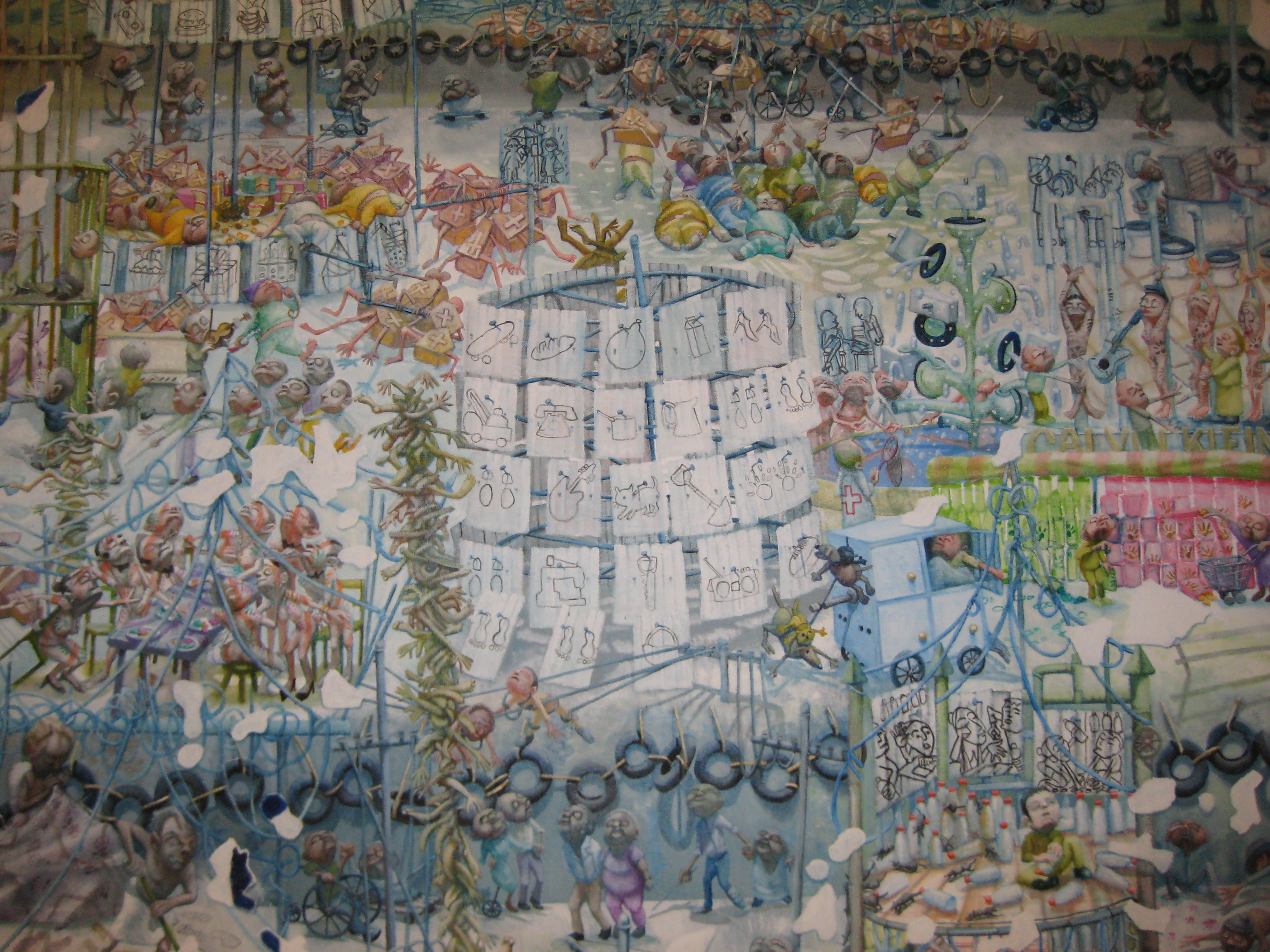
After everyone went blind, everyone was afraid they wouldn’t be able to remember what they now couldn’t see. And everyone became overprotective of their memories and antagonistic towards any contradicting memories. When someone died everyone thought they should build the coffin in the shape of their memory of the dead person. Many corpses were torn apart in the fight for their right to their contradicting memories of the dead. Some grievers agreed on a compromise but had to squash or cut off parts of the hardening corpse to fit it into the compromised coffin shape.

Fingerprints and footprints became an important part of recording where you were and who you were when your memory failed you. The city became covered with fingerprints and footprints. And it became illegal to wash any surfaces. Because of this the world became an incubator of disease and then was ruled by disease. Also models had to be touched now instead of looked at and modelling became the most unglamorous job ever there was.
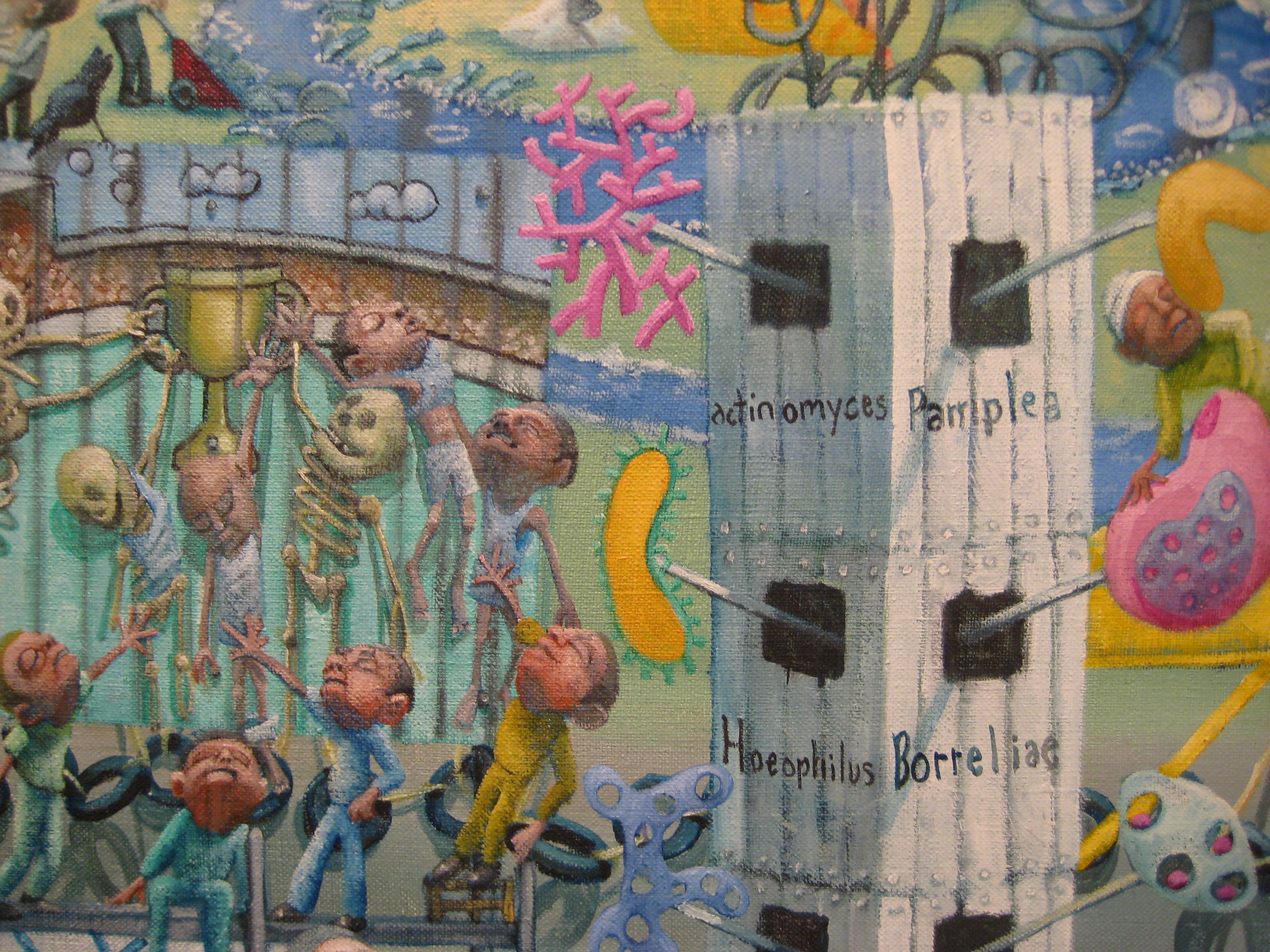
When people couldn’t see they became more aware and afraid of the things they could never see in the first place ; like radio waves, love and bacteria. Bacteria like Tibercle, Entamoebe and Bacilli became household names and there was even a petting zoo of bacteria.

Most people try to keep their memories through taste. They would have cake, soft drinks and lollies to remember their childhood, junk food to remember their teenage years and alcohol for the rest. They mainly became fat which wasn’t a big deal because no-one could see them anyway.


What happens when pretend politicians pretend to be terrorists

What happens when pretend politicians pretend to be terrorists

Cameron Hayes
What Happens When Pretend Politicians Pretend to Be Terrorists, 2011
Oil on linen
66 x 136 inches
Photo: Bill Orcutt
Courtesy Ronald Feldman Fine Arts, New York
In the week of the 2007 Australian federal election, it was clear that the Liberal Party were going to lose power to The Labor Party after 11 years in government. The electorate of Lindsay was made up of middle to lower earning white Australians with pockets of immigrants and first generation Australians from the Middle East. The seat was held by Jackie Kelly for 11 years, but she was retiring and hoping to pass the seat onto a Liberal Party colleague, Karen Chijoff, on the Thursday before Saturday’s election. The husbands of Kelly and Chijoff were seen putting pamphlets in the Lindsay voters’ letter boxes.

The husbands had invented THE ISLAMIC AUSTRALIA FEDERATION. They printed pamphlets from this fake organization, thanking the Labor Party for seeking clemency for terrorists, building more mosques in Llndsay, and for supporting the Bali bombers. The husbands put the fake pamphlets in letterboxes in the poorest white areas.

This painting is about what happened in the local girl’s school and the local shopping mall when the white parents thought that the “Islamic Australia Federation” was targeting Lindsay to be an Islamic/Sharia enclave, with mosques on every corner, bombs in every bus shelter, and most frightening, women with scarves on their heads. The white fear of Lindsay becoming Islamic spread to the schools and made the most vulnerable (Muslim girls) the most accountable for the fear. The Muslim girls already in semi-denial were forced to completely deny their identity.
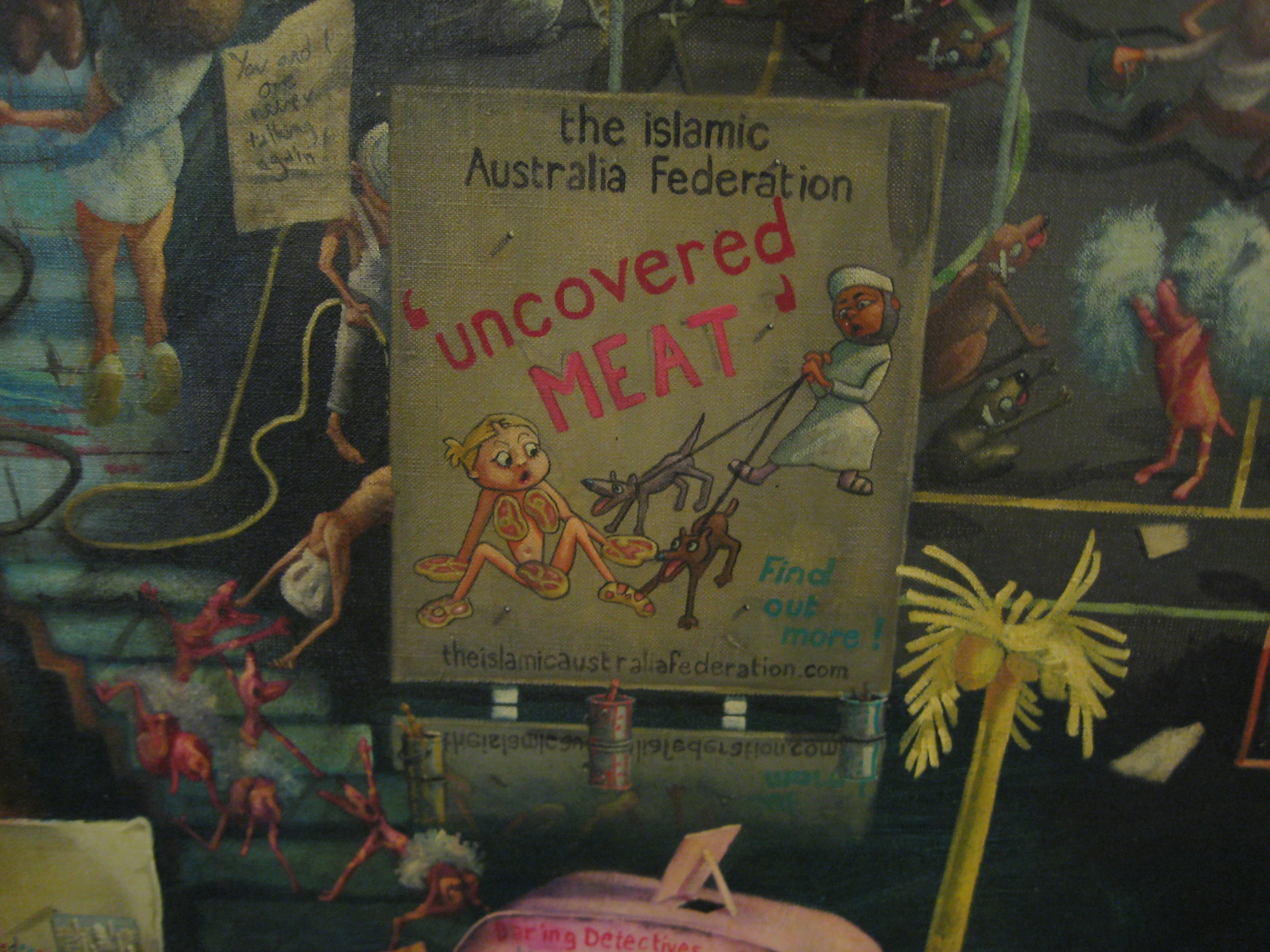
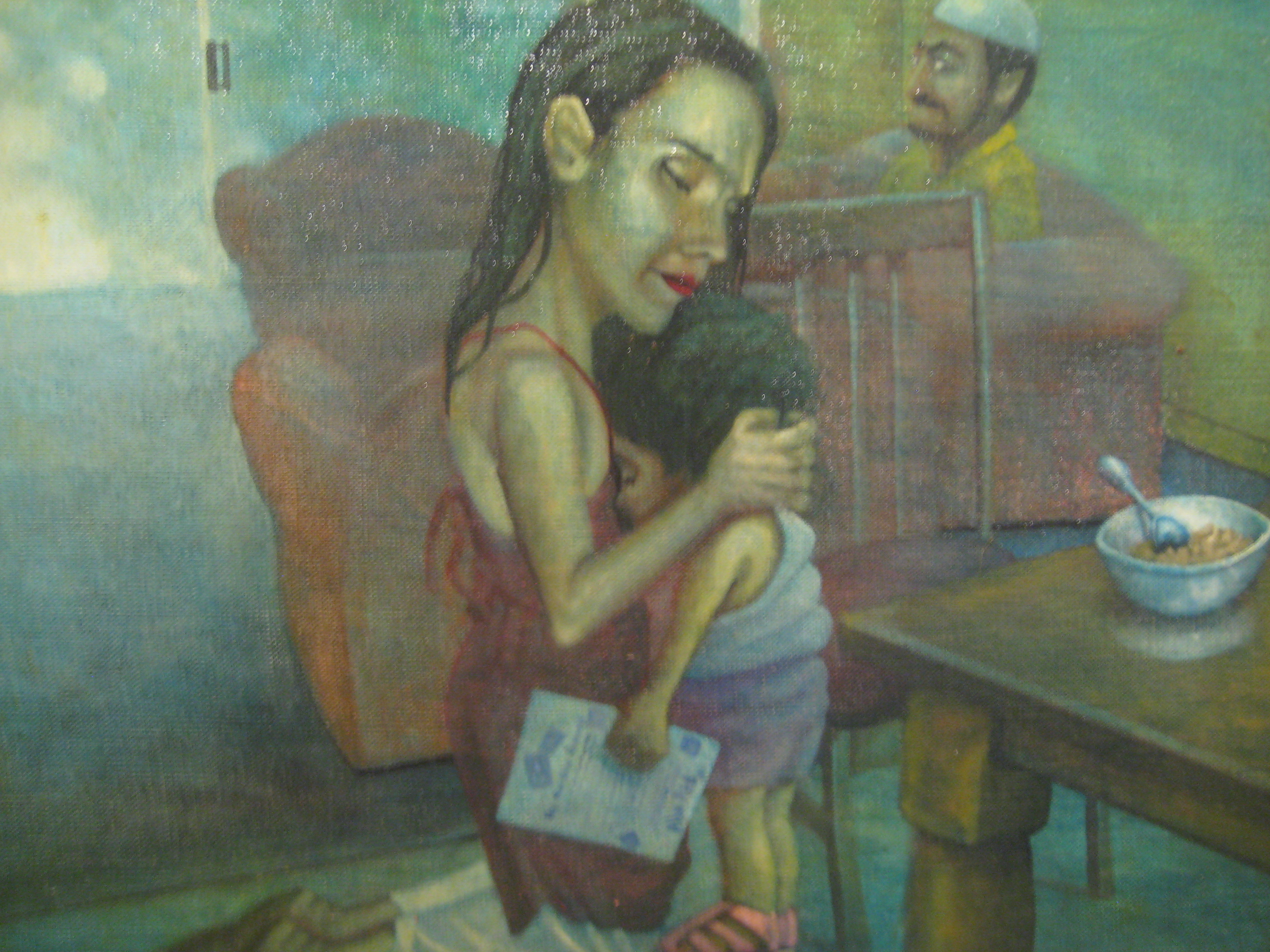
They had to leave home in traditional dress and change at bus stops and the shopping mall, semi-naked in front of predatory white men – cleaners, gardeners, and business men. The girls had to hunt around shopping malls for the cheapest possible versions of non – Muslim dress: singlet tops, short shirts, high heels, and brand names. While their parents, particularly their fathers, did laps at the mall, anti-clockwise, oblivious to the children’s struggle.

Once the girls had given up their identity and started to desire to be someone else, they became nothing and extremely vulnerable to drugs, alcohol, boys, and brands.

Orphanages make the best skyscrapers
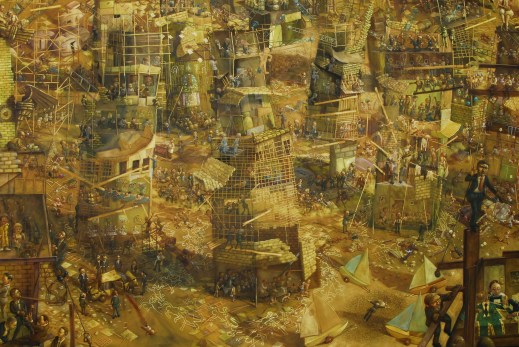
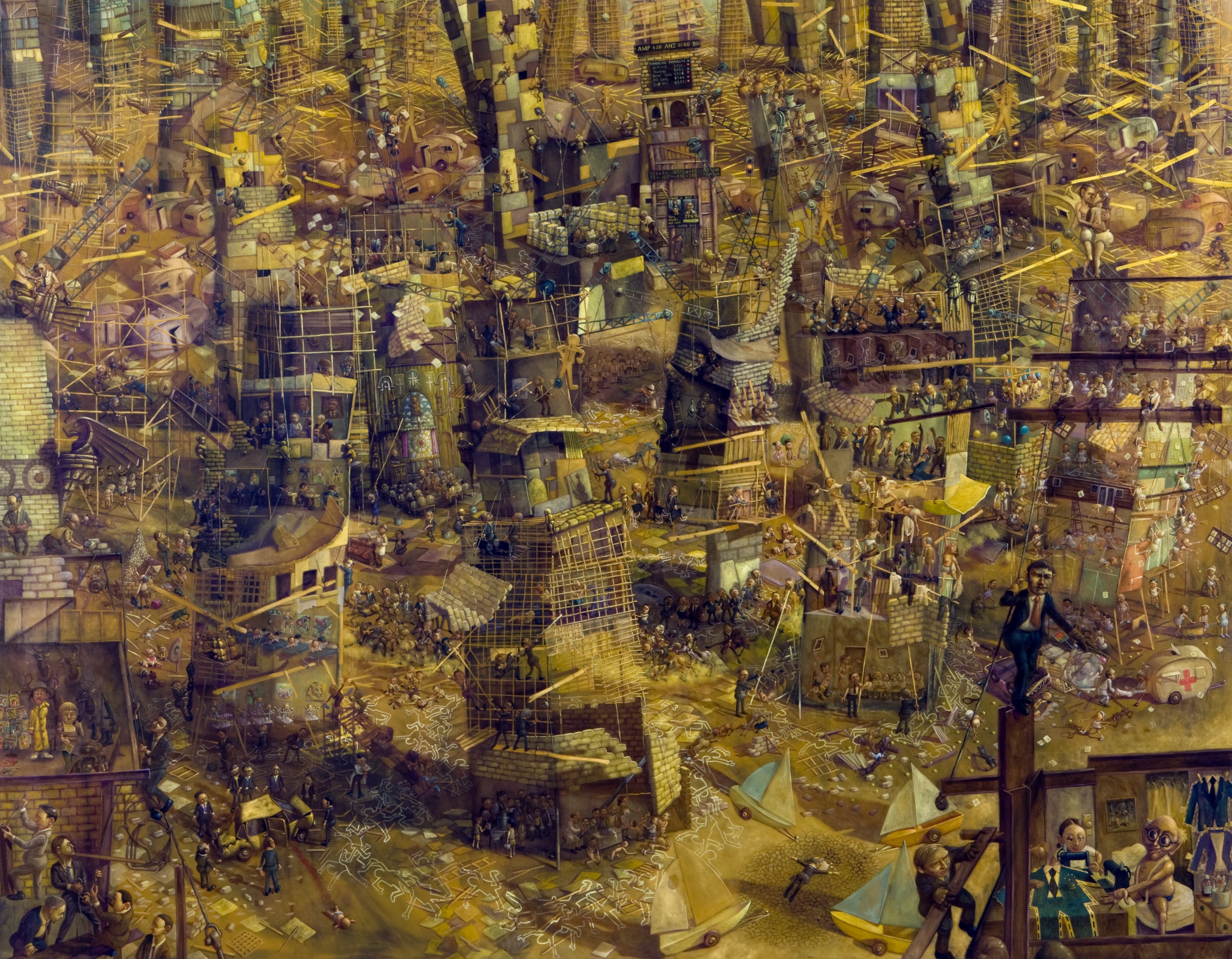
Cameron Hayes
Orphanages Make the Best Skyscrapers, 2011
Oil on linen
78 x 100 inches
Photo: Bill Orcutt
Courtesy Ronald Feldman Fine Arts, New York
Orphanages make the best skyscrapers, 2011
Orphans make up the best corporations because so many of the people who work in them, especially investment bankers, lawyers, and management consultants, need to win the approval of older men in suits. The more neglected a child is, especially as a boy by his father, the harder he will work as an adult for the corporation.
 The rise of conservatism in the working population is a direct result of the increase of absent and negligent fathers.
 The Human Resource departments of big companies see a generation of needy workers unconsciously drawn to being patted on the head by rich old white men in suits. HR departments know these people will take work home, work for unpaid overtime, eat lunch at their desk, and adopt the goals and values of the corporation as their own.
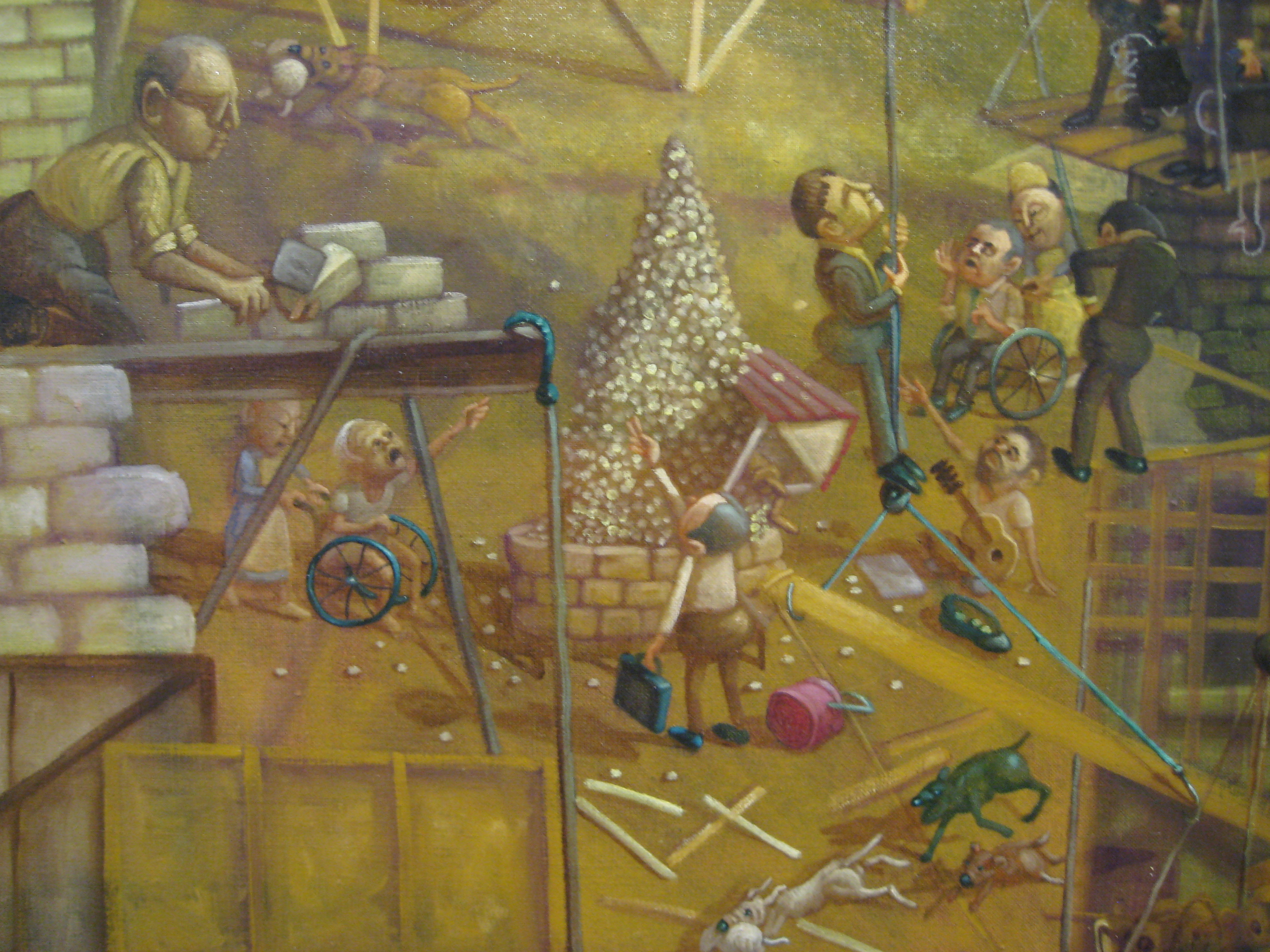 Without fathers, these workers still live in the wish fulfilled fantasy world which they and their mothers created. They expect everyone else to know intuitively what they want and how they feel. They believe in blowing out candles, gambling, and throwing money in wishing wells. They pray in front of gym equipment as orphans pray in front of phones that don’t ring for them, empty letterboxes, and taxis that never return their fathers.
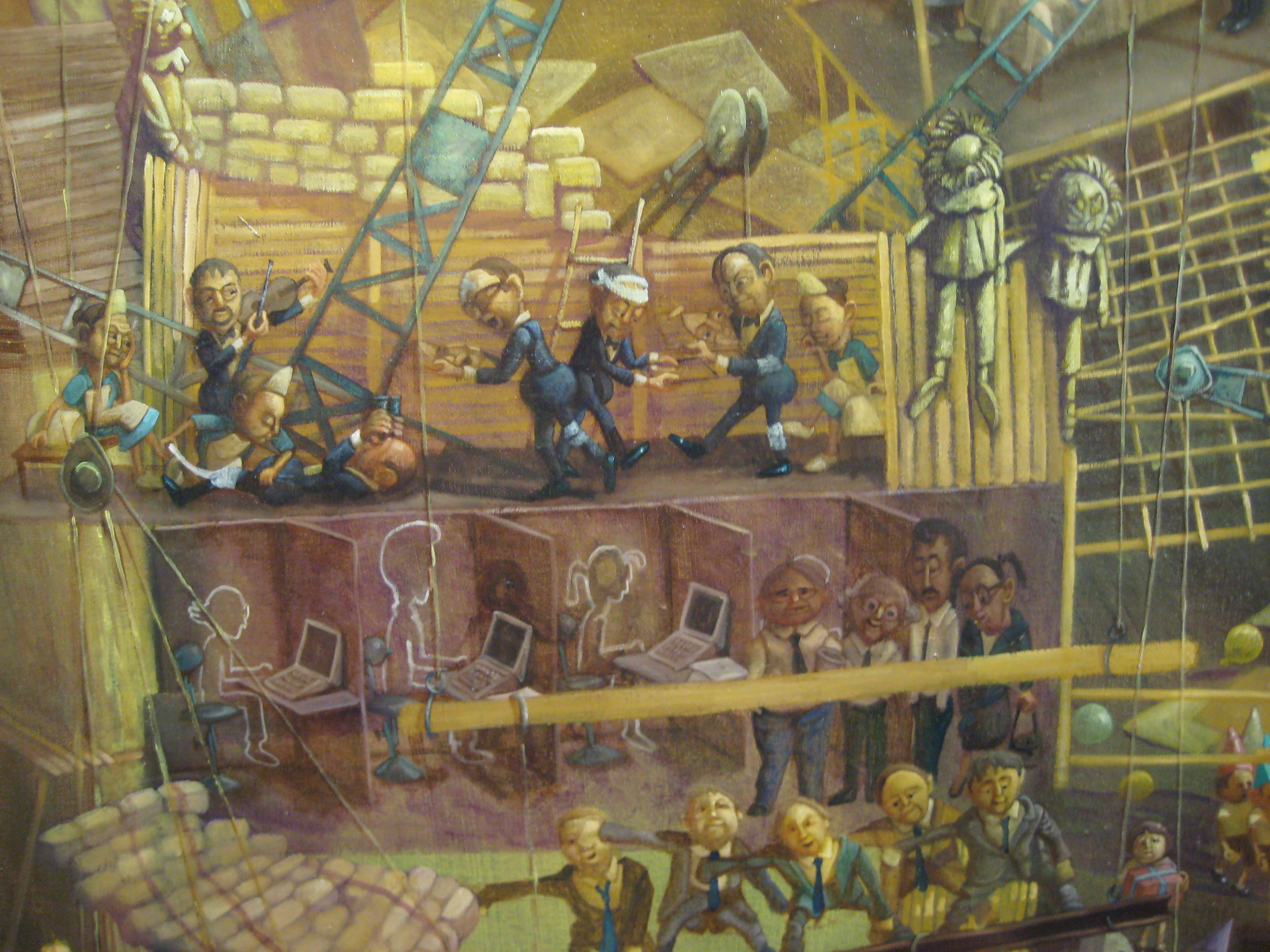
In these skyscrapers the elevators only go up. Not to strive to the top through work is to freefall to the bottom. Many workers carry their chalk drawings in their brief cases, and many psychiatrists are sent straight to the top of the skyscrapers to wait for the most successful workers.
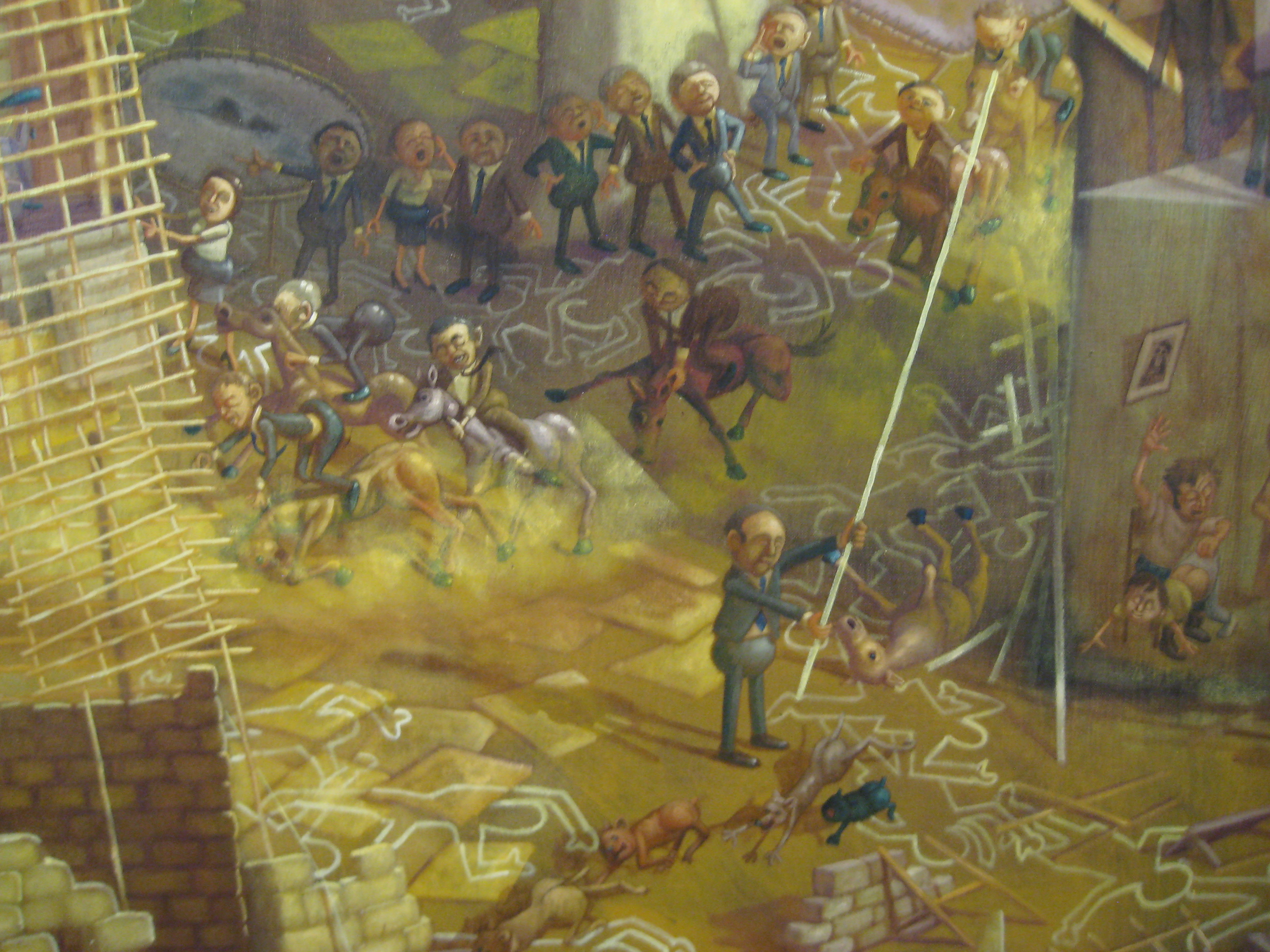
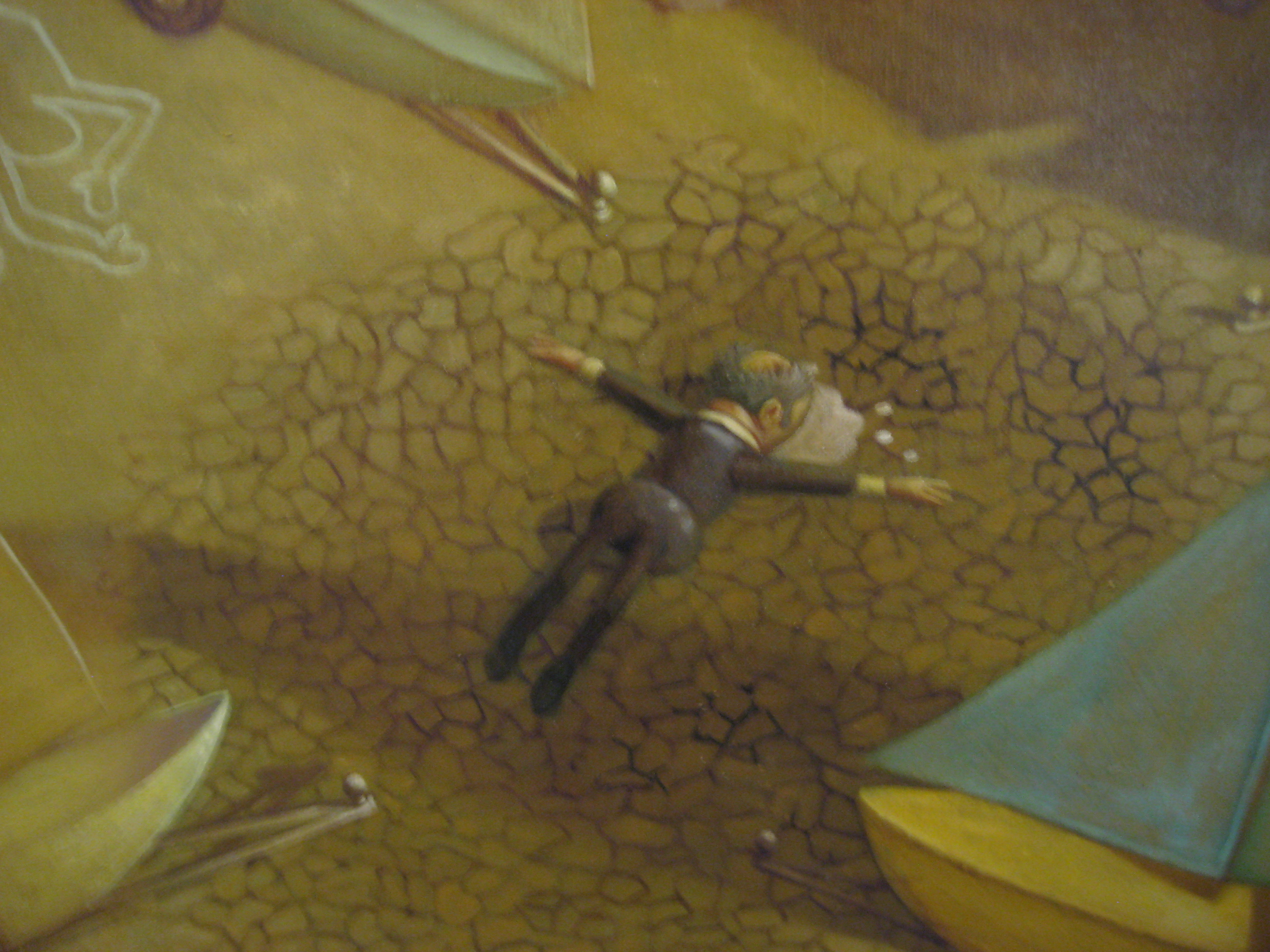
The rats in the monkey’s cage
The rats in the monkey’s cage, 2011

Cameron Hayes
The rats in the monkey cage, 2011
Oil on linen
78 x 60 inches
Photo: Bill Orcutt
Courtesy Ronald Feldman Fine Arts, New York
At the Mumbai Zoo the star attraction is the rhesus monkeys, and because of this, the zoo management has given them the biggest cage proportionate to their size. They are fed the best by the zoo staff and the visitors who ignore the “Don’t Feed the Animals” sign. The monkeys hang on to the ropes and cling to the car tires tied to the bottom of the ropes.
If you throw some food onto the cage floor, the monkeys will lean down from the rope and stretch for the food. The rats lay in wait for the monkeys to leave their rope prisons and to go for the food. They attack instantly and, all together, chase the hungry monkeys back up the rope or up the cage walls. Then you notice the bloodied bandages around the feet and hands of the monkeys, the faces of the monkeys that never sleep, and their stomachs that never get filled. The rats in India are the meanest in the world, and in the zoos they are the fattest. They bully all the animals in the zoos from the elephants to the lions.
This painting is about the many star attractions in the world which are really miserable and under the control of the rats under the surface.
 cameronkhayes